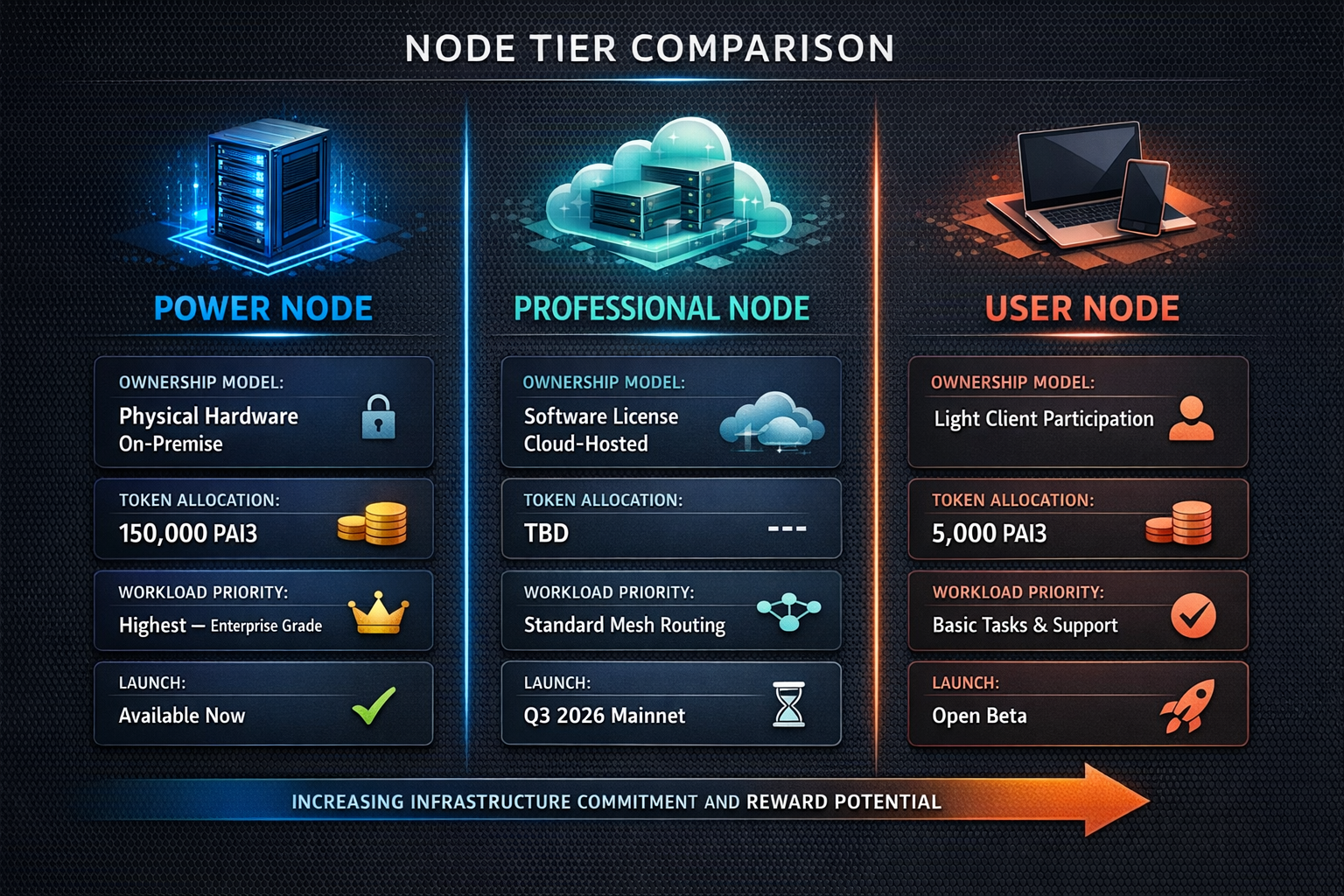
The Power Node is a physical hardware device shipped to your location. Not a cloud instance. Not a software licence. Not an NFT representing a claim on someone else's server. You unbox it, connect it to power and network, and within approximately five minutes you have an operational AI inference machine connected to the PAI3 mesh. That five-minute figure covers the initial guided configuration — linking the node to the network and registering it to your BNB Chain wallet. Full enterprise deployment, including selecting specific AI models for regulated workloads, compliance review, and integration with existing systems, takes longer. Expect the hardware setup to be genuinely fast; expect the business deployment to require the same diligence any enterprise infrastructure demands.
Hardware Specifications
As of the time of writing, PAI3 has not published detailed hardware specifications for the Power Node — including GPU/CPU model, RAM, storage capacity, power consumption, physical dimensions, noise level, or cooling requirements. This is a significant gap for any prospective buyer. Before committing thousands of dollars to a hardware purchase, you should demand answers to the following from official channels:
- ›GPU/CPU: What processor handles AI inference? Is it a general-purpose GPU (e.g., NVIDIA) or custom/proprietary silicon? This determines both the node's inference capabilities and its residual value if the network ceases to operate.
- ›RAM and storage: How much memory and local storage does the device have? This constrains which AI models can run locally.
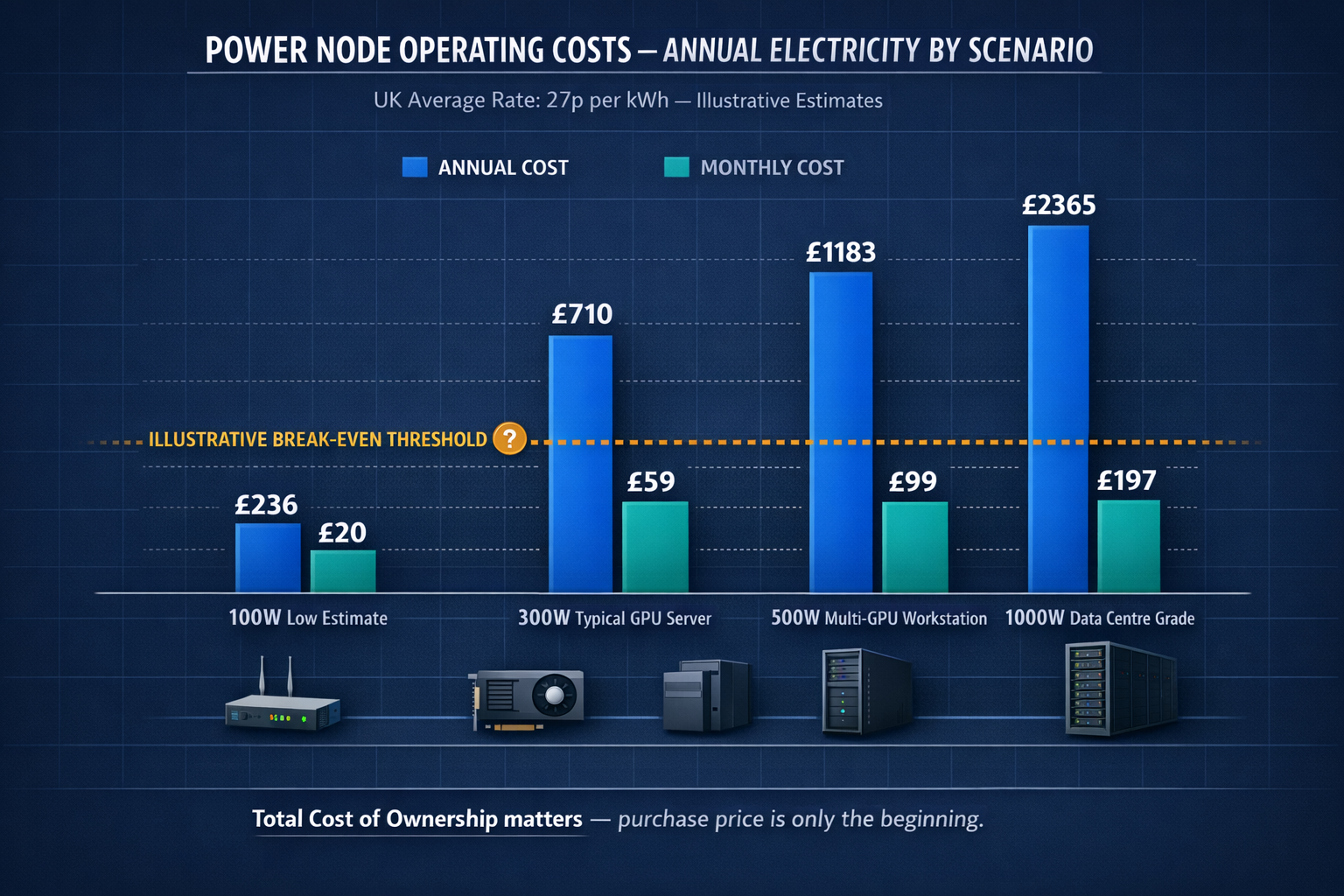
- ›Power consumption: What is the expected wattage under load? UK electricity rates averaged approximately 27p/kWh in 2025 — without knowing power draw, you cannot calculate ongoing operating costs.
- ›Dimensions and noise: Can this sit in a home office, or does it require a server rack? Is it actively cooled with fans that produce data-centre-level noise?
- ›Cooling requirements: Does the device require ambient temperature control or dedicated cooling infrastructure?
If the hardware is general-purpose compute (standard GPU + CPU), it retains value for other workloads if PAI3's network were to shut down. If it is custom silicon purpose-built for PAI3's inference protocol, it has near-zero residual value outside the network. This distinction is material to your risk assessment and PAI3 has not clarified it publicly.
Shipping, Warranty, and Returns
For UK buyers purchasing a physical device from a non-UK seller, several practical considerations apply:
- ›Import duty and VAT: If the Power Node ships from outside the UK, import VAT at 20% applies on goods valued over £135. Depending on the declared value and HS classification, customs duty may also apply. Factor this into your total cost basis.
- ›Warranty terms: PAI3 has not publicly detailed the warranty period, coverage terms, or RMA (Return Merchandise Authorisation) process. Before purchasing, confirm what happens if your node arrives damaged or fails within the first 12 months.
- ›Consumer Rights Act 2015: If the seller is not a UK-based entity, the protections of the Consumer Rights Act 2015 (including the right to reject faulty goods within 30 days) likely do not apply. Your recourse in the event of a dispute may be limited to the seller's own policies and the jurisdiction specified in their terms of sale.
- ›Shipping origin: Confirm the country of manufacture and shipping origin, as this affects both delivery timelines and duty calculations.
Pricing and Token Allocation
Each Power Node comes with an allocation of 150,000 $PAI3 tokens at the Token Generation Event (TGE), scheduled for Q2 2026. That allocation is a token quantity, not a dollar value. Since $PAI3 hasn't launched — no market price exists, no exchange listings are live — the eventual value of that allocation depends entirely on TGE pricing, market demand, liquidity depth, burn rate, and network adoption post-launch. Anyone quoting specific ROI figures for a Power Node purchase is fabricating numbers. This includes any implied ROI derived from multiplying 150,000 tokens by speculative token prices circulating in community channels.
Critical omission: PAI3 has not publicly confirmed whether the 150,000 token allocation is fully liquid at TGE or subject to a vesting schedule. If tokens vest over 12–24 months (common for node allocations in similar projects), your liquidity profile and tax treatment change dramatically. A fully vested allocation is immediately available for staking, trading, or governance. A vesting allocation means you receive tokens gradually over months or years, which affects your ability to participate in early governance, provide liquidity, or recover capital. Confirm the vesting terms directly with PAI3 before purchasing.
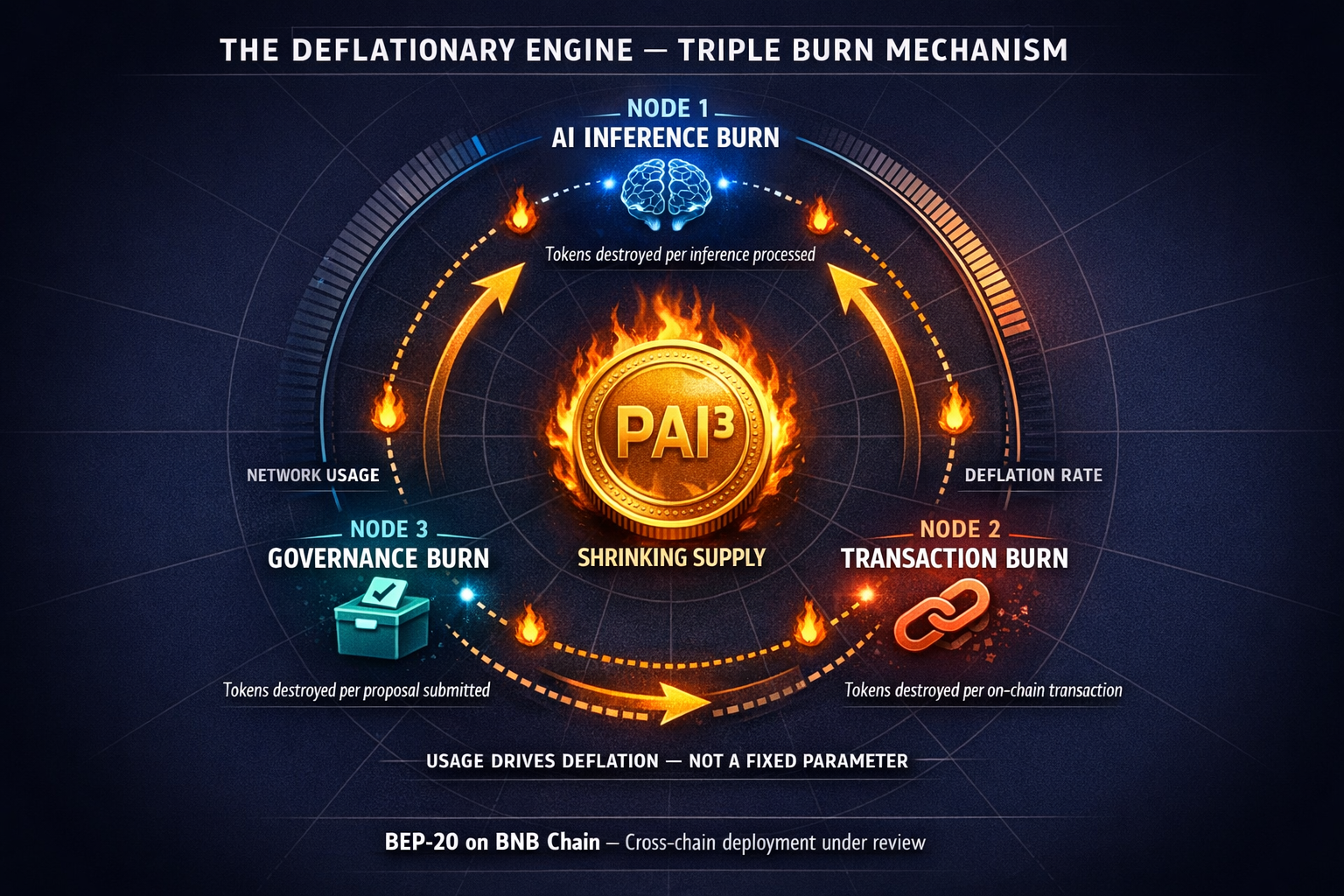
Additionally, a BEP-20 token at TGE may have thin order books, wide bid-ask spreads, and limited exchange listings. The 150,000 token figure creates an anchoring effect that readers will inevitably multiply by speculative prices — but there is no guaranteed liquidity at TGE. You may not be able to sell at the prices you see quoted in early trading.
What you can assess is the cost basis: Power Nodes use a progressive pricing curve that increases as more units sell. PAI3 project materials reference a final pricing tier of approximately $38,013 at 1,000 nodes sold, though this specific figure has not been independently verified from official public documentation — confirm the exact pricing through official channels at https://pai3.ai before purchasing. With PAI3 reporting over 500 already purchased, the remaining inventory sits in the upper half of that curve. The exact pricing tiers between 500 and 1,000 nodes matter for your cost-per-token calculation and are worth confirming directly before purchasing.
Compliance Architecture
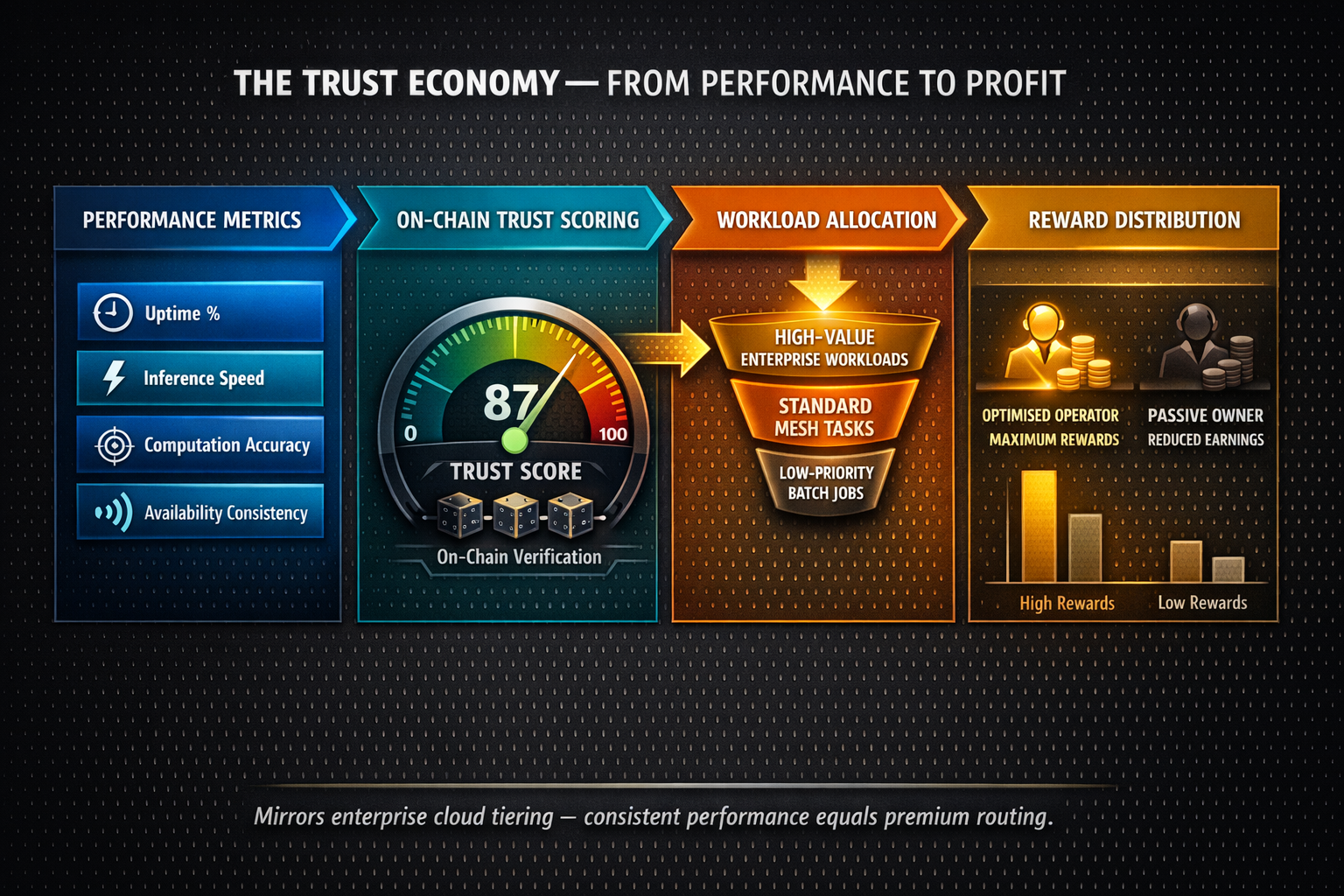
The compliance angle is where Power Nodes diverge most sharply from every other node product in crypto. The architecture is designed to be HIPAA-compliant — meaning sensitive data processed on the node never leaves the local environment. No patient records transmitted to a third-party cloud. No financial data routed through someone else's infrastructure. However, it's important to note that on-premise processing alone is not unique — any organisation running AI models locally (including open-source tools like Ollama on a local server) keeps data local. PAI3's differentiator is on-premise processing PLUS mesh network participation PLUS token economics — the combination of local privacy with a decentralised compute marketplace. The "decentralised" aspect refers to how compute capacity is shared across the mesh and how governance operates, not to where your private data ends up. What gets verified on-chain is the proof that inference occurred correctly — the Trust Economy scoring mechanism — not the underlying data itself.
⚠ Common mistake: Assuming HIPAA compliance means PAI3 holds a HIPAA certification. HIPAA doesn't certify technology vendors — it regulates covered entities and their business associates. PAI3 provides the technical architecture (on-premise processing, encryption, access control) that makes compliance achievable. The legal compliance burden still sits with the deploying organisation.
---