What is PAI3? Decentralised AI Infrastructure Explained
Covers how PAI3's decentralised node network, deflationary token, and DePIN model challenge centralised AI providers. After reading, you'll know which node type fits your goals and how $PAI3 economics work.
→Identify the data custody and vendor lock-in risks of centralised AI APIs
→Distinguish Power, Professional, and User Node roles and commitment levels
→Explain how triple-layer token burns tie deflation directly to AI inference demand
→Recognise why hardware ownership differs from renting GPU time on Akash or Render
01
The Problem With AI You Don't Own
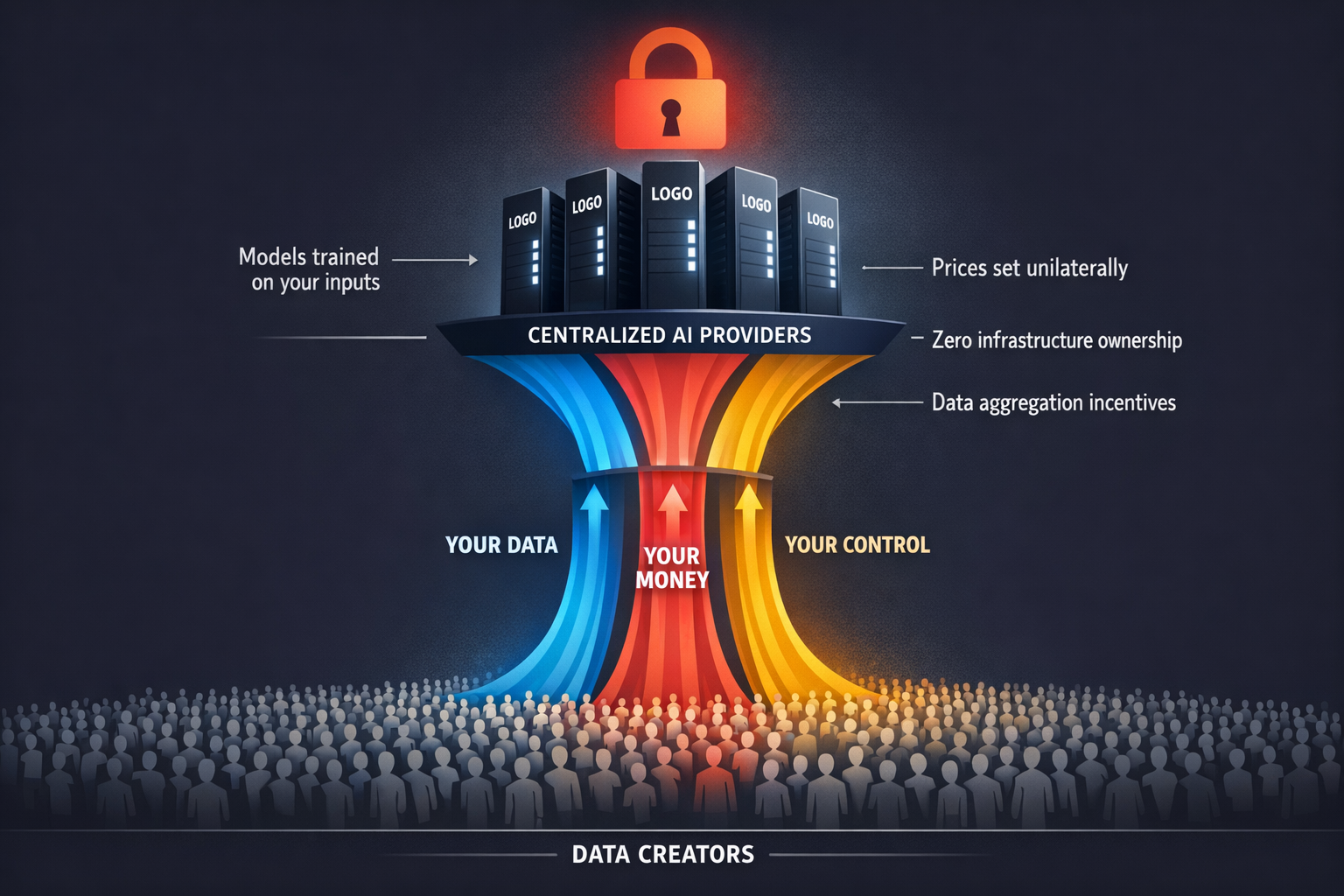
A flow diagram showing millions of users funneling data, money, and control upward to a tiny cluster
Every time you use ChatGPT, Google Gemini, or Claude, you're sending your data to someone else's servers, paying for the privilege, and receiving zero ownership of the infrastructure that processes your request. The AI industry's default business model looks like this: a handful of trillion-dollar companies own the hardware, control the models, set the prices, and collect your data. Free-tier consumer products routinely use inputs to improve models, and while enterprise API tiers from major providers (including OpenAI since March 2023) typically exclude customer data from training by default, the structural incentive remains: centralised providers benefit from aggregating as much data as possible.
This isn't a conspiracy theory — it's the default economics of centralised infrastructure. For casual use, the trade-off is acceptable. But the moment sensitive data enters the equation — patient health records, legal case files, government intelligence, financial models — sending queries to a cloud API controlled by a single corporation becomes a regulatory, ethical, and strategic liability.
›Data custody risk: Every API call to a centralised AI provider sends your input data to their servers. In healthcare, this can violate HIPAA. In government, it creates national security exposure. In finance, it breaches client confidentiality norms.
›Vendor lock-in: Build your workflows around OpenAI's API, and switching costs skyrocket. Your prompts, fine-tuning, and integrations become hostage to one company's pricing decisions.
›Single point of failure: When OpenAI's servers go down — which happens — businesses solely reliant on their API without fallback providers (such as Azure OpenAI, Anthropic, or local models) go dark simultaneously.
›Rent-seeking economics: You pay per token, per query, per month. The infrastructure you fund with those payments belongs entirely to the provider. You build no equity in the system.
›Regulatory pressure: The EU AI Act, HIPAA enforcement, and data sovereignty mandates across dozens of jurisdictions are tightening. Organisations that cannot prove where their data is processed, and who controls the hardware doing the processing, face growing legal exposure.
What this means for you: If you use AI for anything beyond casual questions, you're currently renting intelligence from companies that own every layer of the stack — and you're accumulating zero leverage as their most loyal customer.
02
How DePIN Changes the AI Power Dynamic
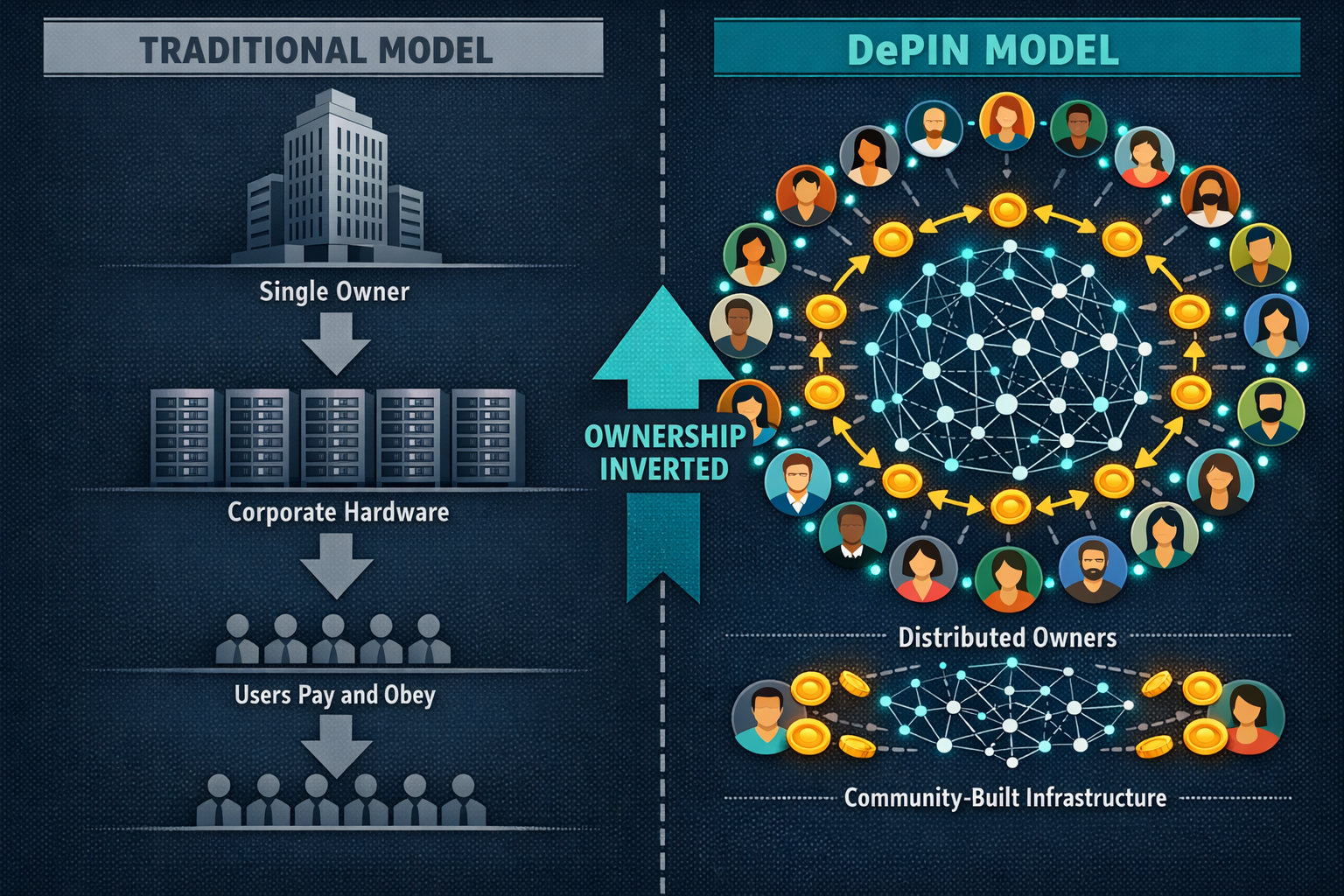
A sidebyside structural comparison contrasting the traditional topdown corporate infrastructure mode
Before examining PAI3 specifically, it helps to understand the broader category it belongs to. DePIN — Decentralised Physical Infrastructure Networks — is a model where, instead of a corporation building and owning infrastructure (cell towers, servers, mapping vehicles), thousands of individuals are incentivised to build and own that infrastructure using token rewards.
This model has been tested in the real world, though with instructive caveats. Helium applied it to wireless networks — individuals bought hotspots, provided coverage, and earned HNT tokens. However, Helium also demonstrated the risks of DePIN: real demand lagged far behind infrastructure deployment, many operators saw minimal returns, and the project migrated from its own blockchain to Solana in 2023 amid declining confidence. Hivemapper applied the model to mapping — drivers mounted dashcams, collected street-level imagery, and earned HONEY tokens — though its commercial traction and coverage remain limited. These projects demonstrated that the DePIN mechanism works for bootstrapping infrastructure, but they also exposed demand-side challenges that any DePIN project — PAI3 included — must overcome.
PAI3 applies DePIN logic to AI compute. AI inference is the fastest-growing compute category — making it potentially the highest-value DePIN vertical, though this depends on whether decentralised networks can capture meaningful share of that demand from entrenched centralised providers.
Here's the economic inversion that makes DePIN conceptually powerful: in the traditional model, users pay corporations for infrastructure access. In DePIN, users are the infrastructure — and they get paid for providing it. The person who buys a PAI3 Power Node isn't a customer. They're a co-owner of a distributed AI network, earning from every inference their hardware processes.
›Hardware ownership vs. rental: Akash and Render let you rent GPU time on someone else's hardware. PAI3 sells you the hardware outright. You own the silicon. This distinction matters enormously for data custody and compliance — though it also means bearing depreciation, maintenance, electricity costs, potential hardware failure without an SLA, and obsolescence risk. For a device costing $20,000–$38,25k+, these are significant financial considerations.
›Aligned incentives: When node operators earn more as the network grows, they're economically motivated to maintain uptime, upgrade capacity, and attract enterprise users — without a management team forcing them.
›Censorship resistance: No single entity can shut down the network or deny service. For government and enterprise use cases requiring sovereign AI (AI infrastructure not controlled by any foreign corporation or single point of authority), this is a structural requirement, not a feature.
What this means for you: DePIN flips the economics of infrastructure. Instead of paying a tech giant for AI access, you become part of the infrastructure and earn from it. PAI3 is the DePIN model applied to AI compute — but the model's track record in other sectors shows that bootstrapping supply is easier than generating demand. Whether PAI3 overcomes this pattern is the central question.
03
What PAI3 Actually Is: The 60-Second Version
PAI3 is a decentralised AI infrastructure network where individuals and organisations own physical hardware, run AI models privately on their own premises, earn tokens for contributing compute power, and govern the system through community voting. (Note: PAI3 has been associated with the tagline "People's AI" in some materials; readers should verify this expansion and the significance of the "3" — which may reference Web3, a version number, or the three node tiers — directly via PAI3's official channels.)
The architecture inverts OpenAI's model entirely. Instead of one company owning thousands of GPUs in a data centre and renting access to millions of users, PAI3 distributes purpose-built hardware to hundreds (and eventually thousands) of individual operators. Each operator owns their machine outright. AI models run locally on that machine. Sensitive data never leaves the operator's building. And every time someone uses the network, operators earn $PAI3 tokens while a small amount of those tokens is permanently destroyed — burned — reducing total supply over time.
An important caveat: a distributed mesh of nodes running open-source models will not match the performance of frontier models like GPT-4 or Claude for general-purpose tasks. PAI3's value proposition is privacy, ownership, and censorship resistance — not model capability parity with the largest centralised providers. For enterprises that need sovereign, on-premise inference with specific compliance requirements, this trade-off may be worthwhile. For those prioritising raw model quality above all else, it may not be.
Three layers make this work:
›Physical nodes — real hardware devices owned by participants that provide the raw compute power for AI inference (the process of running a trained AI model to produce outputs from new inputs)
›Decentralised mesh network — a peer-to-peer communication layer where nodes discover each other, route requests, and coordinate work without a central server directing traffic
›Trust Economy — a verification and reputation system that proves AI computations were performed correctly and scores node operators on reliability
PAI3 has been building through 2024–2026. The PAI3 Foundation and a DUNA (Decentralised Unincorporated Nonprofit Association — a Wyoming legal structure that gives decentralised organisations legal personhood without traditional incorporation) have been established. The testnet has been operational, with activity reported from 2025 (verify the precise launch date with PAI3's official communications for current status). PAI3 states that over 500 Power Nodes have been sold. PAI3 also states that more than 40 enterprise partners across healthcare, government, and finance are engaged with the project — though "engaged" has not been publicly defined (it could mean signed contracts, letters of intent, pilot programs, or preliminary conversations), and no specific partners have been named publicly.
What this means for you: PAI3 isn't asking you to rent AI from yet another company. It's offering you ownership of the physical infrastructure, privacy over your data, ongoing token earnings, and a vote in how the network evolves. But it's pre-mainnet, and many claims remain unverifiable by independent sources — treat them accordingly.
04
Who Is Building PAI3?
Any project selling hardware at $20,000–$38,25k+ demands transparency about who is behind it. As of this writing, PAI3 has not prominently publicised its founding team, key technical leads, or their prior project histories through independently verifiable channels (such as named LinkedIn profiles, prior blockchain or AI projects, or published research).
The PAI3 Foundation and DUNA legal structures provide some institutional framework, but the absence of publicly identifiable team members is a gap readers should note. Before committing capital — especially at Power Node price levels — investigate:
›Who are the founders? Look for named individuals on PAI3's official website, blog posts, or conference appearances.
›What is their track record? Prior experience in AI, hardware manufacturing, blockchain infrastructure, or enterprise sales is relevant.
›Is there a doxxed team? In crypto, anonymous teams carry higher counterparty risk. If the PAI3 Foundation dissolves or the team abandons the project, hardware owners have limited recourse.
If PAI3 publishes team information after this article's publication, we will update this section. If they have not, treat this as a risk factor proportional to the capital you're considering.
05
PAI3's Three Node Types: Power, Professional, and User
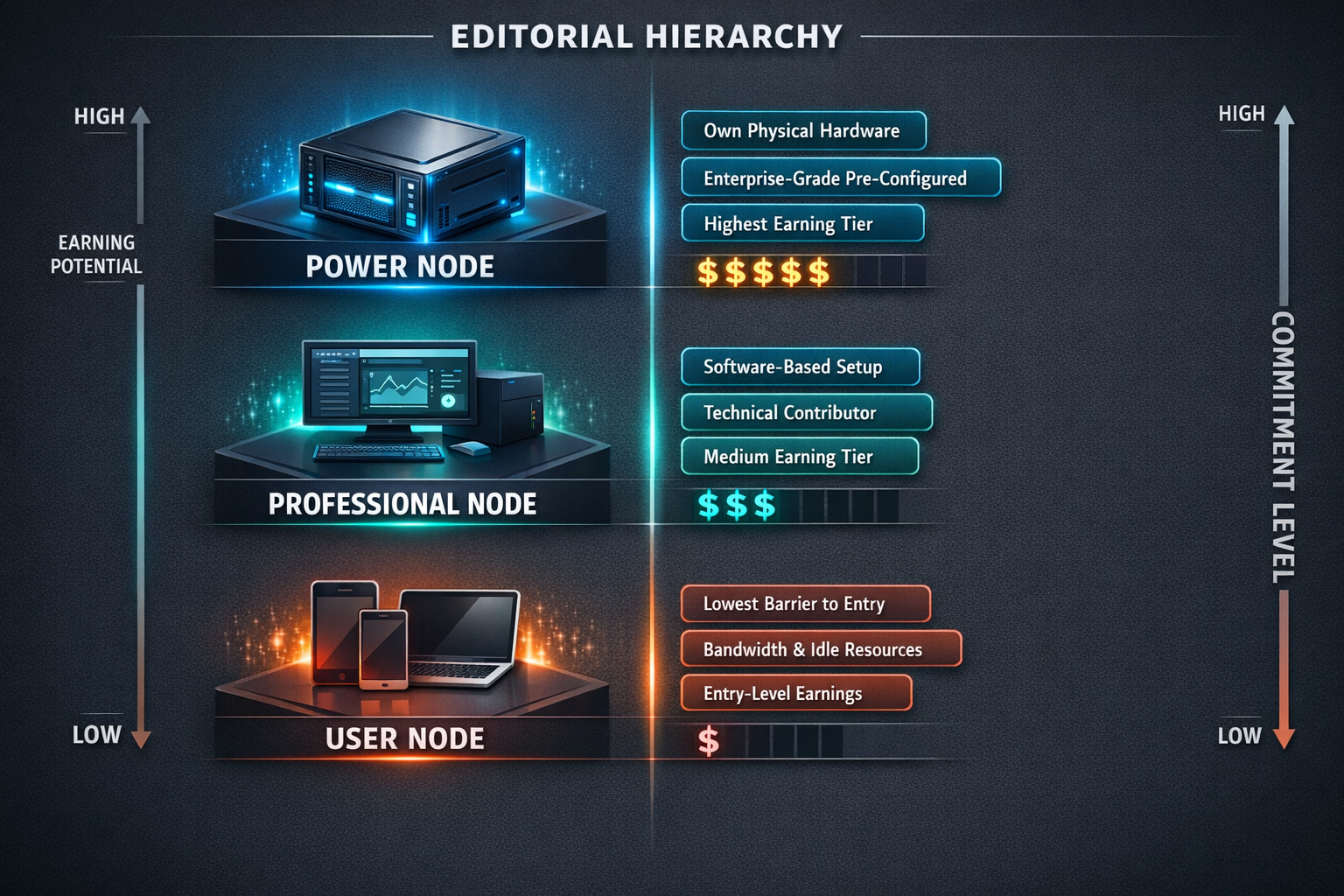
A threetier visual hierarchy showing Power, Professional, and User nodes with their distinct roles,
PAI3 structures its network into three tiers. Each serves a different role, requires a different level of commitment, and earns proportionally.
Power Nodes: The Network Backbone
Power Nodes are physical hardware devices that PAI3 ships to your location. You purchase the device outright — you own it. These are not DIY server builds requiring technical expertise. PAI3 describes setup as taking approximately five minutes, closer to plugging in a home router than assembling a mining rig. The hardware is purpose-built, pre-configured, and enterprise-grade.
What's inside the hardware? PAI3 has not published detailed hardware specifications (RAM, GPU model, storage capacity, power consumption) publicly at the time of writing. This is a critical gap: buyers need to know what AI models the hardware can actually run, what size models it supports (7B parameters? 13B? 70B?), and how it compares to self-built alternatives. Before purchasing, demand specific hardware specs and confirm which open-source models (e.g., Llama, Mistral, or others) are supported and at what performance level.
Each Power Node receives an allocation of 150,000 $PAI3 tokens at TGE (Token Generation Event — the moment the token officially launches and becomes transferable). However, without knowing the total token supply, this number cannot be evaluated in context — 150,000 tokens could represent significant or trivial value depending on total supply and circulating supply at TGE (see the Token section below for further discussion). Power Node pricing follows a tiered model that increases as more are sold — according to PAI3's published pricing schedule, scaling toward approximately $38,013 USD at the 1,000th node. With PAI3 reporting 500+ already sold, later buyers pay more for the same 150,000 token allocation. Early operators have a lower cost basis per token — a deliberate early-mover incentive.
Power Nodes are designed with an architecture intended to satisfy the technical safeguard requirements of HIPAA (the US law governing health data privacy) by ensuring sensitive data never leaves the local environment where the node operates. However, it is important to understand that HIPAA certification does not technically exist as a formal credential — organisations self-attest compliance through risk assessments and Business Associate Agreements. "HIPAA-compliant architecture" means the system is designed to meet technical requirements, but HIPAA compliance also requires administrative safeguards (staff training, policies, access management) and physical safeguards (facility security, device controls) that are the operator's responsibility, not the hardware's. Enterprises in healthcare, legal, and financial sectors should conduct their own compliance assessments before relying on any vendor's compliance claims.
Hardware ownership trade-offs: Owning the hardware means you bear all associated costs and risks: electricity, physical maintenance, potential hardware failure (with no enterprise SLA guaranteeing replacement timelines), depreciation, and obsolescence. If superior hardware emerges in 2–3 years, your node may become uncompetitive. Unlike renting GPU time on Akash or Render, where you can switch providers instantly, hardware ownership locks capital into a depreciating physical asset.
Professional Nodes: The Scalability Layer
Professional Nodes are software-based — no specialised hardware required. Operators stake (lock up) $PAI3 tokens to participate and earn rewards proportional to the compute they contribute. These open to the public at mainnet launch, targeted for Q3 2026.
At the time of writing, PAI3 has not published full details on several critical Professional Node parameters:
›Minimum stake requirement: How many $PAI3 tokens must be locked?
›Hardware recommendations: What specs (CPU, GPU, RAM, bandwidth) are needed to operate a Professional Node competitively?
›Reward ratio vs. Power Nodes: How do Professional Node earnings compare per unit of compute contributed?
›Slashing mechanism: Under what conditions can staked tokens be confiscated (e.g., downtime, incorrect inference results, malicious behaviour)? What percentage is slashed?
Professional Nodes create an intended economic flywheel: staking locks supply (reducing tokens in circulation), while expanded compute capacity attracts more enterprise demand, which burns more tokens through inference fees. However, this flywheel depends on real enterprise demand materialising — without it, staking simply locks tokens with limited return. Once staking parameters are published, you can model potential returns using our staking calculator.
User Nodes: The Mass Participation Layer
User Nodes allow personal devices to contribute lighter compute to the network. These are designed for broad participation, not as a primary income stream. Rewards are proportional to compute contributed, which for consumer hardware will be modest compared to Power or Professional Nodes.
Key details remain unspecified:
›Eligible devices: Can you run a User Node on a laptop, desktop, mobile phone, or single-board computer (e.g., Raspberry Pi)? What are the minimum specifications?
›Software requirements: Is there a desktop app, mobile app, or browser-based client?
›Realistic earnings: Even a qualitative range (e.g., "enough to offset electricity costs" vs. "negligible") would help participants set expectations.
›Current status: User Nodes are planned for broader rollout — they are not yet live at the time of writing.
The three tiers together are designed to create a resilient mesh: Power Nodes provide the backbone and compliance-ready infrastructure, Professional Nodes extend capacity dynamically, and User Nodes add ambient compute from potentially millions of devices.
What this means for you: Your entry point depends on your commitment level. Power Nodes are for those ready to invest in hardware ownership now — with full awareness of the financial risks of a $20k–$38k+ depreciating asset. Professional Nodes suit participants who want software-based involvement after mainnet. User Nodes are the lightest option for contributing to and participating in the network. For all three tiers, critical operational details remain unpublished — factor this uncertainty into your decision.
06
The $PAI3 Token: Deflationary Economics for AI Compute
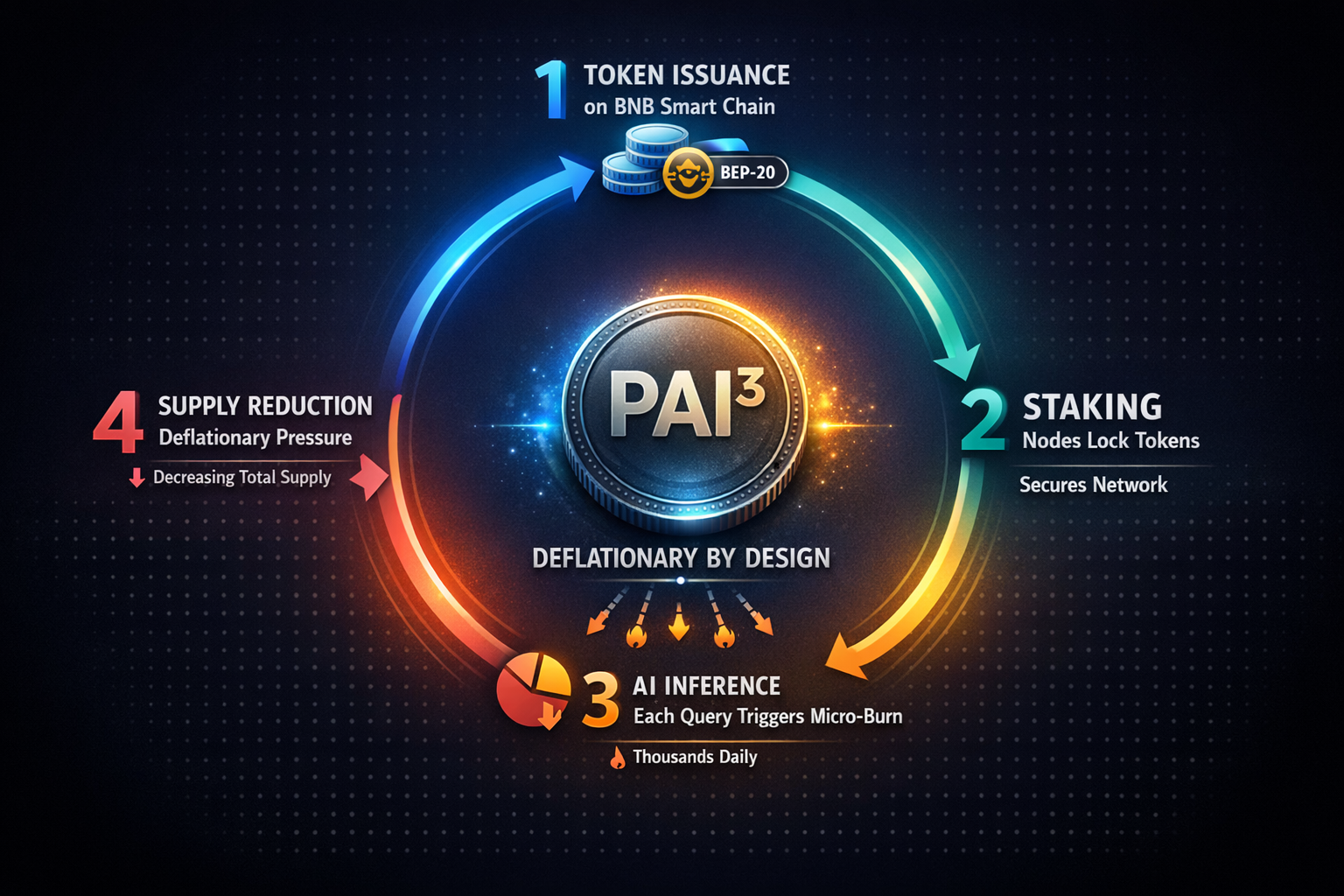
A circular lifecycle diagram tracing a PAI3 token from issuance through staking, inference microburn
$PAI3 is a BEP-20 token on BNB Smart Chain (the smart-contract-capable chain within the broader BNB Chain ecosystem, which also includes the BNB Beacon Chain using the BEP-2 standard). BEP-20 is comparable to ERC-20 on Ethereum. The choice of BNB Smart Chain is pragmatic: gas costs are lower than Ethereum L1 (though Ethereum L2s like Arbitrum and Base now offer comparable or lower fees), which matters when every AI inference burns a small amount of tokens (thousands of micro-transactions daily). The existing DeFi ecosystem provides liquidity infrastructure, and bridge accessibility lets users move assets between chains.
Total Supply, Distribution, and Vesting
PAI3 has not publicly disclosed the total token supply, circulating supply at TGE, or detailed vesting schedules at the time of writing. This is a critical gap for anyone evaluating the project's tokenomics. Without the total supply denominator, it is impossible to assess:
›Whether the 150,000 tokens per Power Node represent meaningful value
›The real dilutionary impact of team and ecosystem allocations
›Whether burn rates will meaningfully affect supply
What is known: distribution spans node rewards (150,000 per Power Node), community and ecosystem development, team allocation (vested — meaning released gradually over time, not all at once), DAO treasury, and liquidity provisions. However, no percentage breakdown has been published.
A rough calculation illustrates why this matters: 150,000 tokens × 1,25k+ planned Power Nodes = 150 million+ tokens allocated to node operators alone. If the total supply is 1 billion, that's 15%+ of supply to node operators. If it's 10 billion, it's 1.5%. The economics are radically different in each scenario.
Vesting matters enormously. The exact vesting schedule, unlock cadence, and cliff periods for the 150,000 $PAI3 Power Node allocation have not been fully detailed. A 150,000 token allocation unlocking 100% at TGE is radically different from one vesting linearly over 24 months with a 6-month cliff. Similarly, team token vesting terms (cliff length, linear unlock period, total duration) have not been published. Large unlock events — sometimes called "cliff unlocks" — can create significant sell pressure. Scrutinise these details when they are published.
We will update this section when PAI3 publishes its full tokenomics. Until then, treat the absence of this information as a material risk factor.
Triple-Layer Deflationary Burns
This is where most explanations go wrong. Many tokens call themselves "deflationary" based on a single burn mechanism, typically a small transaction fee. $PAI3 burns tokens across three independent activity types:
1. AI inference burns — every time an AI model runs a computation on the network, tokens are burned. This ties token scarcity directly to AI demand.
2. Transaction burns — standard transfers and marketplace activity burn tokens.
3. Governance proposal burns — submitting proposals for community votes costs tokens that are permanently destroyed.
The key nuance: deflationary pressure scales with network usage. Until mainnet drives real inference volume (targeted Q3 2026), burn rates will be minimal. Burns reduce supply, but if demand for the token is flat or declining, price can still fall. Token burns are a supply-side mechanism, not a price guarantee. Many tokens with burn mechanics have declined in value because demand did not keep pace. If adoption is slow, the deflationary mechanism has little practical effect.
Token Utility
$PAI3 isn't just a reward token. It serves five distinct functions within the network:
›Staking: Required for Professional Node operation, governance participation
›Payment: Used to pay for AI services across the network
›Governance voting: Staked tokens determine voting power (via quadratic voting — more on this below)
›Marketplace transactions: Buying and selling AI agents, models, and services
›Rewards: Earned by node operators for contributing compute
Secondary Market and Liquidity
$PAI3 is not yet tradeable. At TGE (targeted Q2 2026), PAI3 plans exchange listings on both centralised and decentralised exchanges, though specific exchange names have not been officially confirmed. Before TGE, there is no official secondary market for $PAI3 tokens. Key questions to monitor:
›Which exchanges will list $PAI3 at launch?
›What is the initial liquidity provision (how much capital backs the trading pairs)?
›Will there be a pre-TGE market or OTC trading?
›What lockup restrictions, if any, apply to Power Node token allocations at TGE?
Once $PAI3 launches and you begin receiving node rewards or trading, you'll need to track every transaction for tax purposes. In the UK, HMRC treats crypto token rewards as income at the point of receipt. Tools like Koinly can automatically import BEP-20 transactions, and you can estimate your potential capital gains tax obligation using our free CGT calculator.
UK Tax and Regulatory Considerations
For UK-based participants, several tax and regulatory questions arise that go beyond standard crypto trading:
›Power Node purchase: HMRC may treat the hardware as a capital asset. Depreciation treatment for crypto mining/inference hardware is not explicitly addressed in HMRC guidance — consult a tax professional.
›150,000 token allocation at TGE: HMRC's guidance on mining and staking rewards suggests these would likely be classified as miscellaneous income at the point of receipt, taxed at your marginal income tax rate based on the token's market value at the time you receive them. This could create a significant tax liability even if you don't sell.
›Ongoing node rewards: Similarly treated as income at receipt. If you later sell tokens at a higher price, the gain above the income-taxed value is subject to Capital Gains Tax.
›FCA considerations: The sale of hardware bundled with token allocations could, depending on structure, raise questions under the Financial Services and Markets Act (FSMA) about whether the arrangement constitutes an investment contract or a regulated financial product. The FCA's evolving approach to crypto assets — and the lack of specific guidance on DePIN hardware sales — creates regulatory uncertainty.
›Currency note: All prices in this article (including the ~$38,013 node pricing) are denominated in USD unless otherwise stated. At current exchange rates, this is approximately £30,25k+ GBP, though the exact figure varies. Confirm the purchase currency directly with PAI3.
This is not tax or legal advice. UK participants considering Power Node purchases should consult a qualified tax adviser and, for larger commitments, a financial regulatory specialist.
What this means for you: $PAI3 is designed so that the more useful the network becomes, the scarcer the token gets. But scarcity alone doesn't create value — demand does. And without knowing the total supply, you cannot evaluate the magnitude of any deflationary effect. Watch for the full tokenomics publication, then monitor real adoption metrics (active nodes, inference volume, enterprise contracts) after mainnet, not just burn announcements.
07
Quadratic Voting: Why One-Token-One-Vote Is Broken
A numeric bar chart comparison showing how quadratic scaling compresses whale influence versus linea
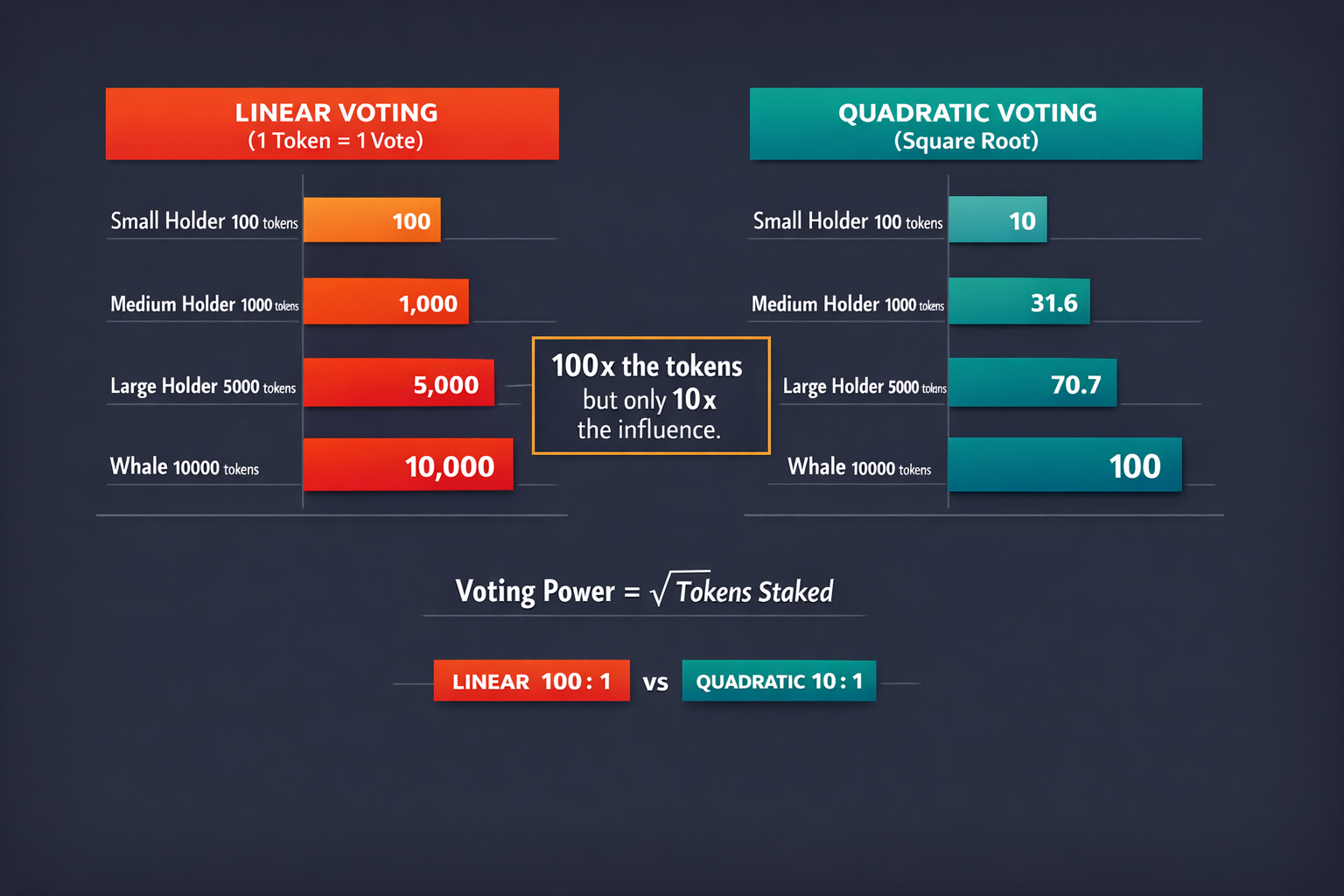
Most DAOs (Decentralised Autonomous Organisations — entities governed by token holders through on-chain voting rather than a board of directors) use one-token-one-vote. The problem is obvious: a single whale holding 51% of tokens controls every decision. You've replaced centralised corporate control with centralised token-holder control — a structural change in name only.
Quadratic voting fixes this by making influence scale with the square root of tokens staked. The maths:
›You stake 100 $PAI3 → your voting power is √100 = 10 votes
›A whale stakes 10,000 $PAI3 → their voting power is √10,000 = 100 votes
›The whale has 100× the tokens but only 10× the influence
The whale still matters — this isn't egalitarianism. But capturing governance requires persuading many participants, not just accumulating tokens. For PAI3's enterprise partners, this is structurally important: no single token holder can unilaterally change fee structures, approve dubious partnerships, or drain the treasury.
The Sybil attack problem: Quadratic voting has a well-known vulnerability. If the whale in the example above splits their 10,000 tokens across 100 wallets of 100 tokens each, they receive 100 × √100 = 1,000 votes — ten times more than the 100 votes they'd get from a single wallet. This means quadratic voting without robust Sybil resistance actually amplifies whale power compared to linear voting.
PAI3's defence against this is a critical design question. Possible approaches include:
›Hardware-bound identity: Each Power Node could serve as a unique identity anchor, making it expensive to create fake identities (you'd need to buy multiple nodes).
›KYC (Know Your Customer): Requiring identity verification, though this conflicts with decentralisation principles.
›Proof of personhood: Emerging protocols like Worldcoin's World ID or Gitcoin Passport that attempt to verify unique humans without full KYC.
PAI3 has not publicly detailed its Sybil resistance mechanism for quadratic voting. Until this is addressed and verified, the quadratic voting benefit remains theoretical — and potentially counterproductive if exploited. This is a question readers should raise directly with the PAI3 team.
The PAI3 community votes on:
›Network upgrades and protocol changes
›AI model scoring and quality rules
›Fee structures for network usage
›Partnership approvals
›Treasury allocation from the DAO fund
What this means for you: Quadratic voting compresses whale influence if and only if Sybil resistance works. Eleven community members each staking 100 tokens (110 total votes) would outweigh a whale staking 10,000 (100 votes) — but ten members at 100 tokens each merely match the whale exactly (100 vs 100). And without Sybil-proof identity, the whale can split wallets and gain more power than under simple one-token-one-vote. Ask PAI3 how they prevent this before treating quadratic voting as a solved problem.
08
The Trust Economy: Verifiable AI in a Trustless World
A threecomponent verification pipeline flow diagram showing verifiable inference, trust scoring, and
Here's a problem most people haven't considered: if an AI model runs on someone else's hardware — even within a decentralised network — how do you know it actually ran correctly? How do you know the node didn't return a cached response, a cheaper model's output, or fabricated data?
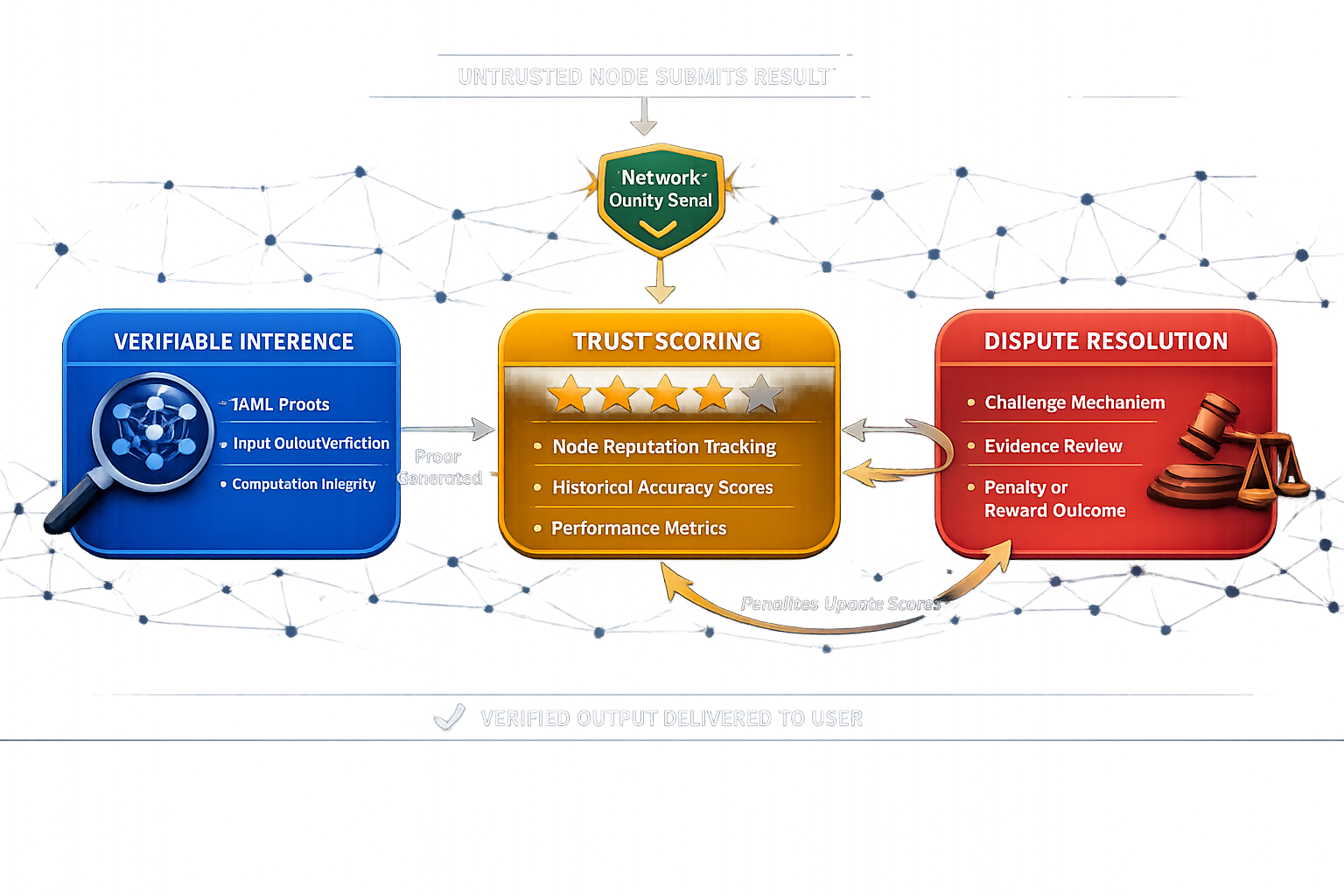
This is the problem verifiable inference attempts to solve, and it's one of the hardest unsolved challenges in decentralised AI. PAI3's Trust Economy is its answer, built on three components:
›Verifiable inference: Mechanisms to prove that a specific AI model processed a specific input and produced a specific output. Industry-wide approaches include zkML (zero-knowledge proofs applied to machine learning — cryptographic techniques that prove a computation happened correctly without revealing the underlying data), optimistic verification (assuming results are correct unless challenged), and TEEs (Trusted Execution Environments — hardware-secured enclaves that isolate computation). Each approach carries different trade-offs: zkML is cryptographically rigorous but computationally expensive for large models; optimistic verification is efficient but relies on economic incentives for challengers; TEEs depend on hardware manufacturer trust (typically Intel or AMD). PAI3 has not publicly specified which verification approach it uses. This is the single most important technical detail for enterprise credibility, and its absence is notable.
›On-chain scoring: Node reliability is tracked on the blockchain. Uptime, response accuracy, and speed create a public, tamper-resistant performance record.
›Reputation staking: Node operators stake tokens as collateral. Think of it like auditors putting up a bond — if they produce bad results, they lose their stake. This creates economic skin in the game.
How Inference Requests Are Routed and Priced
The article would be incomplete without addressing the mechanics of how work moves through the network. When an enterprise or developer submits an AI inference request, several questions arise:
›Routing: Which node handles the request? Is routing algorithmic (based on latency, reputation score, and capacity), marketplace-based (operators set prices and requesters choose), or centrally orchestrated during early network phases?
›Pricing: How is inference priced — per token of output, per second of compute, or via a flat fee? Do node operators set their own prices, or does the protocol enforce a pricing algorithm?
›Quality of service: Are there SLA-like guarantees for response time and accuracy? If a node fails mid-inference, how is the request re-routed?
PAI3 has not published detailed documentation on request routing and pricing mechanics. For enterprise users evaluating PAI3 against centralised alternatives (which offer clear pricing tables and SLAs), this information is essential. We will update this section when details are available.
AgentOS, PAI3's platform for creating and deploying autonomous AI agents, sits on top of this trust layer. AI agents — software that performs tasks autonomously based on instructions — can be built, deployed, and monetised across the trusted mesh. Because agents run as containerised applications (self-contained software packages that include everything needed to run, deployed across different hardware without reconfiguration), they can operate on any node in the network.
The honest assessment: verifiable inference at scale is the technical milestone practitioners will scrutinise most at mainnet launch. PAI3's specific implementation — and the trade-offs it accepts between verification rigour and computational overhead — will determine credibility with serious enterprise users. The fact that the specific approach has not been publicly detailed is itself a data point worth noting.
What this means for you: The Trust Economy is what separates PAI3 from a simple "rent my GPU" marketplace. If it works well, it creates genuine accountability in decentralised AI. But the specific technical approach remains unpublished, and how well it works won't be known until mainnet.
09
Privacy Architecture: Why Data Staying On-Premise Changes Everything
Centralised AI has a structural privacy problem that no terms-of-service update can fix: when you send data to a cloud API, that data physically exists on someone else's server, in someone else's jurisdiction, under someone else's control. For casual use, this is acceptable. For a hospital processing patient records, a law firm analysing case files, or a government agency handling classified information, it's a non-starter.
PAI3's architecture takes a different approach: sensitive data never leaves the local environment where the node operates. AI inference happens on-premise — on hardware you own, in a building you control. The AI model comes to your data, not the other way around.
However, on-premise hardware does not automatically solve all data privacy and compliance requirements. Running inference locally addresses one layer — preventing data from traversing external networks — but comprehensive compliance also requires:
›Access controls: Who can physically and digitally access the node?
›Encryption at rest: Is data stored on the node encrypted?
›Audit logging: Are all inference requests and access events logged for compliance review?
›Staff training: HIPAA, GDPR, and similar regulations require human procedural safeguards, not just technical architecture.
›Ongoing maintenance: Security patches, software updates, and periodic risk assessments are the operator's responsibility.
With those caveats clearly stated, PAI3's on-premise architecture does remove the single largest technical barrier to compliance:
›HIPAA considerations: The US law governing protected health information (PHI) requires technical, administrative, and physical safeguards. PAI3's architecture addresses the technical requirement by keeping PHI off external networks. HIPAA certification does not technically exist as a credential — organisations self-attest compliance through risk assessments and Business Associate Agreements. Enterprise partners must still conduct their own comprehensive compliance assessments covering all three safeguard categories.
›Containerised AI: AI models are packaged as modular containers deployed to local hardware. The container runs the model, processes the data, and returns results — all within the node's local environment. No data exposure to the broader network.
›Sovereign AI: For government use cases, no single foreign entity or corporation controls the inference pipeline. The hardware is owned domestically, the data stays within sovereign borders, and governance is distributed across community participants.
This is PAI3's sharpest competitive edge against centralised providers, whose entire business model depends on data travelling to their servers. Decentralised GPU marketplaces like Akash or Render still route data through someone else's hardware. PAI3's model makes the data custodian and the infrastructure owner the same person — a structural advantage for compliance-sensitive use cases, though not a substitute for comprehensive compliance programs.
What this means for you: If you work in (or serve) healthcare, government, legal, or financial sectors, PAI3's privacy architecture addresses the single biggest technical barrier to AI adoption in those industries: data leaving the building. The administrative and physical compliance requirements remain your responsibility.
10
How PAI3 Compares to Alternatives
A structured comparison matrix mapping PAI3, Bittensor, Fetchai, and centralized providers across ke
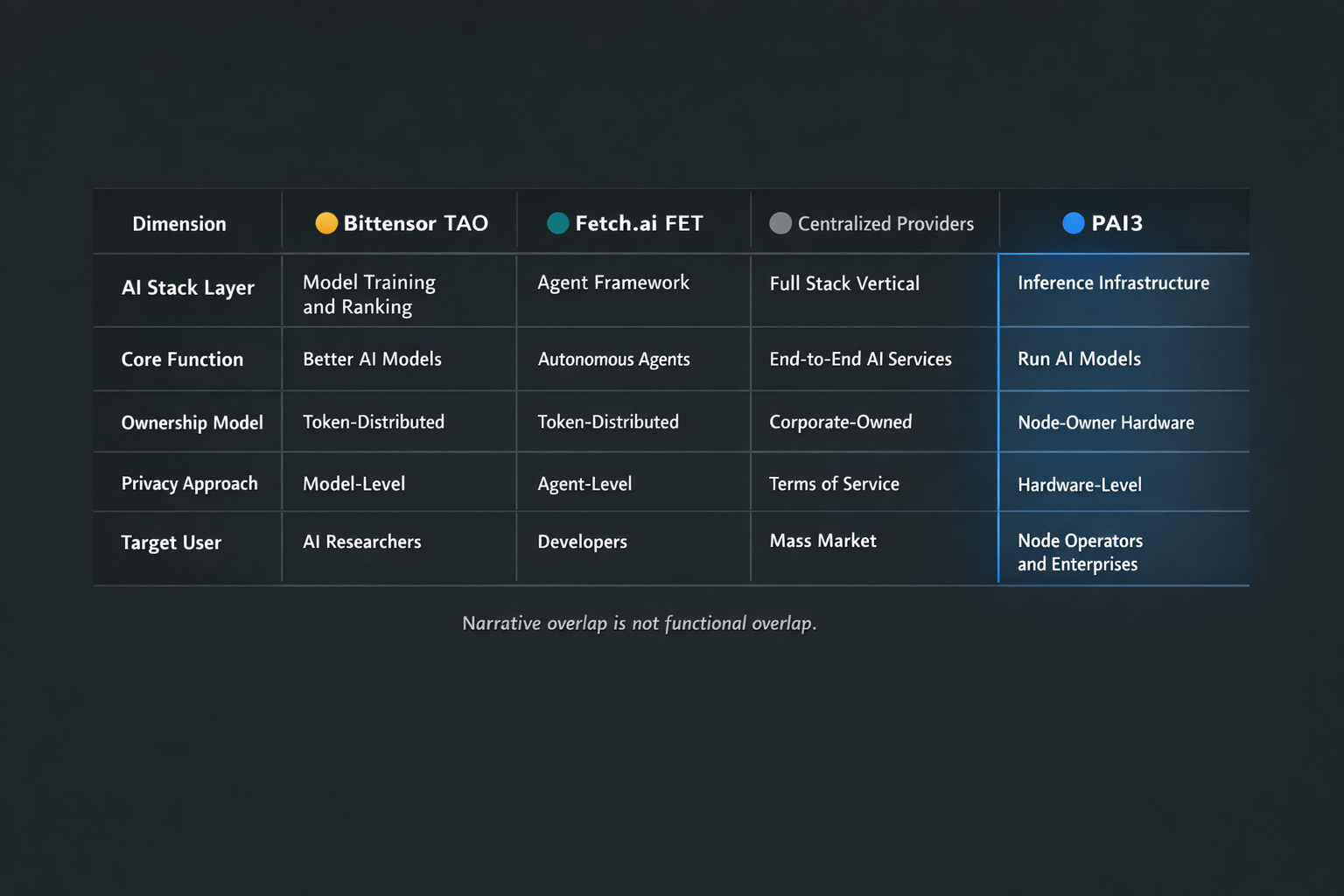
The "decentralised AI" space has several prominent projects, and PAI3 also competes with centralised providers. Understanding what each actually does — rather than grouping them by narrative — reveals where PAI3 sits.
Decentralised Competitors
›Bittensor (TAO): Decentralises AI model training and ranking. Miners compete to produce the best model outputs; validators score quality. This is a different layer of the AI stack. Bittensor produces better models. PAI3 provides the infrastructure to run models. A Bittensor-trained model could theoretically run on PAI3 hardware. The overlap is narrative ("decentralised AI"), not functional. Bittensor has significant traction with a market cap among the top decentralised AI projects.
›Fetch.ai (FET): An autonomous agent framework. Its agent capabilities overlap with PAI3's AgentOS, but Fetch.ai doesn't include physical hardware ownership or on-premise inference. It's a software layer without an infrastructure layer.
›Ocean Protocol (OCEAN): A data marketplace enabling data sharing and monetisation. This is complementary to PAI3, not competitive — data availability is a different problem from compute infrastructure.
›Akash Network: A decentralised GPU compute marketplace where you rent time on other people's hardware. You don't own the GPU. Your data travels to the provider's machine. No built-in HIPAA architecture. However, Akash has a live, functioning marketplace with real usage data — a maturity advantage over PAI3's pre-mainnet status.
›Render Network: Similar to Akash — a GPU rental marketplace focused initially on rendering and expanding into AI. Pay-per-use rental model, not ownership. Render has an established user base, particularly in the creative/rendering space.
›io.net: Aggregates distributed GPU compute into a unified cluster. Focuses on providing GPU capacity at lower cost than cloud providers. Does not emphasise on-premise privacy or hardware ownership.
›Gensyn: Focuses on verifiable ML training (not just inference). Uses a novel verification protocol for distributed training jobs. Complementary layer to PAI3 but tackling a different technical challenge.
›Ritual: Building infrastructure to integrate AI models into blockchain applications. Focuses on on-chain AI inference verification. Some overlap with PAI3's Trust Economy concept.
›Together AI: A platform for running open-source models with a focus on efficiency and cost. Centralised infrastructure with decentralised model access — a hybrid approach.
Centralised Alternatives
For enterprise buyers, PAI3 ultimately competes with:
›AWS / Azure / GCP AI services: Massive scale, mature SLAs, enterprise support teams, broad model selection. The trade-off: vendor lock-in, data custody concerns, and rent-seeking economics.
›OpenAI / Anthropic / Google API access: State-of-the-art model quality. The trade-off: data leaves your environment, pricing is per-token with no ownership, and you depend on a single provider's uptime and policy decisions.
PAI3's differentiator is full-stack integration: hardware ownership + on-premise privacy + AI inference + agent deployment + deflationary tokenomics + quadratic governance — collapsed into a single participant-owned network. No other project combines all of these layers. The trade-off is that PAI3 is pre-mainnet, unproven at scale, and limited to open-source models that cannot match frontier model performance.
What this means for you: Don't think of PAI3 as "competing" with Bittensor or Ocean — they operate on different layers. The real competitive question is whether PAI3's full-stack ownership model delivers enough value to justify the cost, risk, and model-quality trade-offs compared to both specialised decentralised alternatives and mature centralised providers.
11
The Roadmap: Where PAI3 Is Right Now
A horizontal timeline showing completed milestones, the current Q1 2026 phase, and upcoming Q2 2026
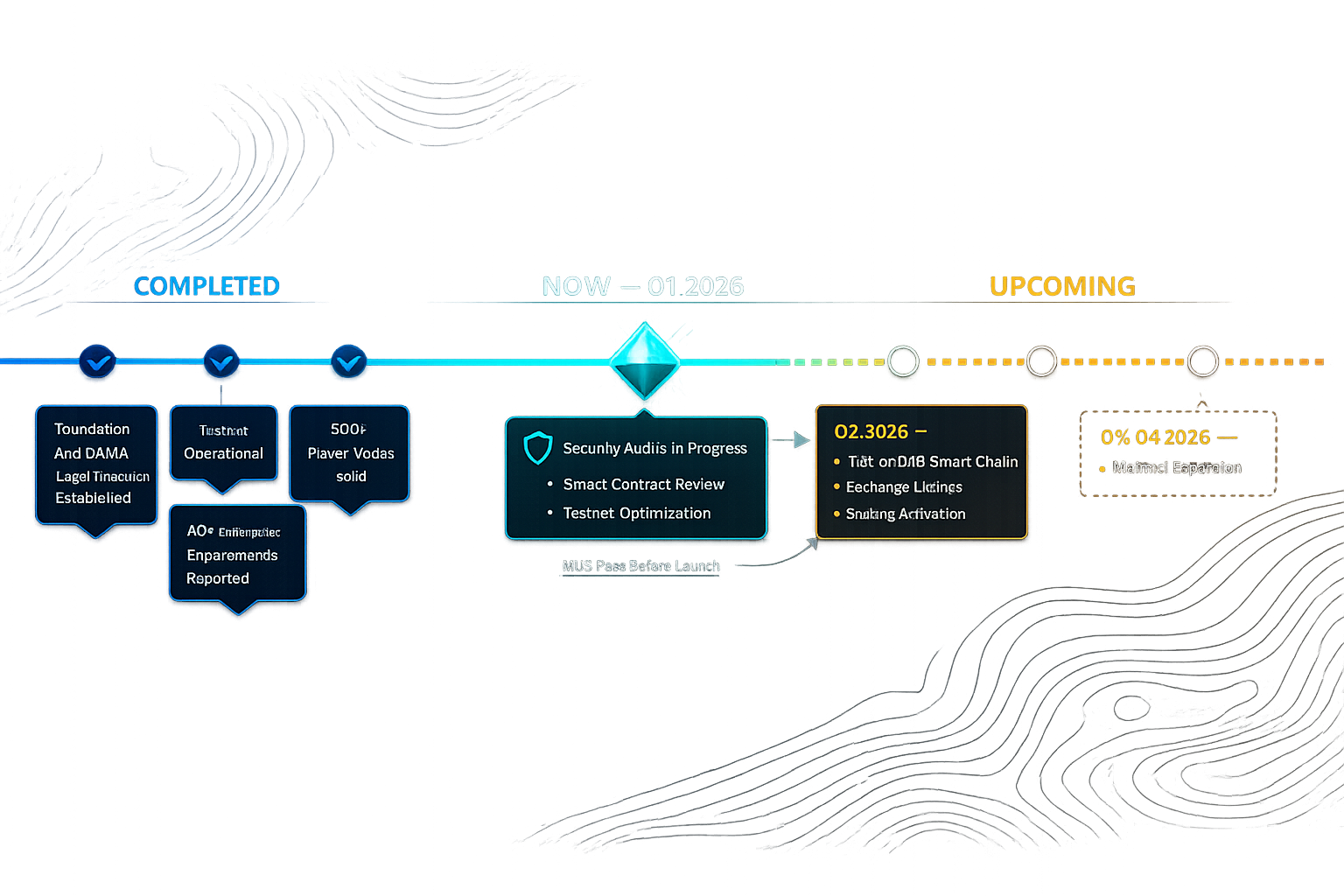
PAI3 is in Q1 2026 right now — the final preparation phase before the token launches. Here's what each stage means in practical terms:
Completed milestones:
›PAI3 Foundation and DUNA legal structures established
›Testnet operational
›PAI3 reports 500+ Power Nodes sold
›PAI3 reports 40+ enterprise engagements (unverified; nature of engagement unspecified)
Right now (Q1 2026): Security audits by third parties are examining the smart contracts that will govern token distribution, staking, burns, and governance. Testnet optimisation continues. This is the "trust but verify" phase — the infrastructure is built, now it needs to prove it's secure before real economic value flows through it.
Q2 2026 — TGE: The $PAI3 token launches on BNB Smart Chain. Exchange listings (both centralised exchanges and decentralised exchanges) begin, though specific exchange names have not been officially confirmed. Power Node operators receive their 150,000 $PAI3 allocations (subject to vesting terms that have not been fully published). Governance voting activates. This is when PAI3 transitions from a development project to a live economic network.
Q3 2026 — Mainnet "World Computer": Full decentralised AI inference goes live. Professional Nodes open to the public, allowing anyone to stake $PAI3 and contribute compute power. The AI services marketplace launches, enabling enterprises and developers to buy inference capacity. This is the milestone that determines whether the architecture works at scale.
Q4 2026 — PAI3 Computer: Consumer hardware designed for mass adoption. If Power Nodes are the enterprise backbone, the PAI3 Computer is the play for millions of everyday participants — affordable, simple, low-power devices that expand the mesh dramatically. This is the most underappreciated roadmap item and the most challenging to execute: consumer hardware needs to be affordable, quiet, energy-efficient, and genuinely easy to use. Shipping reliable consumer hardware is a fundamentally different discipline from building protocol software.
What could delay this timeline: Crypto token launches frequently experience delays. Smart contract audit findings could require remediation. Regulatory developments (FCA, SEC, or EU) could necessitate structural changes. Enterprise partnerships may take longer to convert into mainnet usage than projected. Hardware supply chain disruptions could affect node shipments or the PAI3 Computer timeline.
What this means for you: The next three months (Q2 2026) are the most consequential: TGE determines token economics, exchange listings determine initial liquidity, and governance activation determines whether the community model works. Watch for: specific TGE date, audit report publications, exchange listing announcements, and — critically — the full tokenomics disclosure (total supply, vesting schedules, circulating supply at TGE).
12
Risks, Unknowns, and What Could Go Wrong
No honest guide skips this section. PAI3 has an ambitious architecture and early traction, but several meaningful risks exist. This section is not exhaustive — it covers the most material risks as of Q1 2026.
Execution Risk
›Mainnet is not yet live. All claims about network performance, verifiable inference, and enterprise-grade reliability are untested at scale. The gap between testnet and mainnet is where many crypto projects fail.
›TGE timing: Q2 2026 is "exact date TBA." Crypto token launches frequently experience delays. If audits surface issues, the timeline shifts.
›Consumer hardware (Q4 2026): Shipping affordable, reliable consumer hardware is a different discipline from building protocol software. Manufacturing, distribution, quality control, and customer support at consumer scale are substantial operational challenges.
Technical Risk
›Verifiable inference is unproven at scale: The Trust Economy's verifiable inference mechanism hasn't been tested under real mainnet load, and the specific approach hasn't been publicly detailed. This is the most technically scrutinised component.
›Model capability limitations: A distributed mesh of Power Nodes running open-source models will not match GPT-4, Claude, or Gemini for general-purpose tasks. Enterprises evaluating PAI3 must accept a model quality trade-off for privacy and ownership benefits.
›Hardware obsolescence: AI hardware evolves rapidly. A Power Node purchased today may be outperformed by commodity hardware in 2–3 years. Unlike software-based systems, hardware cannot be upgraded remotely.
Financial Risk
›Node pricing is front-loaded: With PAI3 reporting 500+ nodes sold and pricing scaling toward ~$38,013 USD, later entrants pay significantly more for the same 150,000 $PAI3 allocation. Your break-even depends entirely on token value, which is unknown.
›Token price risk: There is no guarantee that $PAI3 tokens will have or maintain any particular value. Pre-mainnet tokens carry elevated risk — the token may trade below node operators' effective cost basis.
›Vesting details matter: The exact vesting schedule, unlock cadence, and cliff periods for the 150,000 $PAI3 Power Node allocation haven't been fully detailed. A 150,000 token allocation unlocking 100% at TGE is radically different from one vesting over 24 months. Large unlock events can create severe sell pressure. Scrutinise this when details are published.
›Hardware as a depreciating asset: The $20,000–$38,25k+ investment in a Power Node is a depreciating physical asset. Unlike token investments, hardware cannot be sold at market price on an exchange. Resale markets for specialised crypto hardware are illiquid.
Demand Risk
›Burn rates require usage: Deflationary burns are proportional to network activity. If enterprise adoption is slower than projected, the triple-burn mechanism has negligible impact on supply.
›Enterprise partnerships are unverified: PAI3 claims 40+ enterprise partners, but no specific partners have been named, and the nature of "engagement" is undefined. Without signed contracts generating revenue at mainnet, these partnerships may not translate into network usage.
›DePIN demand-side challenges: As Helium and other DePIN projects have demonstrated, bootstrapping supply (selling nodes) is far easier than generating real demand. PAI3 must prove that enterprises will actually pay for inference on its network rather than using established centralised alternatives.
Regulatory Risk
›Securities classification: Selling hardware bundled with token allocations and earnings promises sits in regulatory grey area. If regulators (FCA, SEC, or others) classify this arrangement as a securities offering, it could fundamentally alter the project's structure or legality.
›AI regulation: The EU AI Act and emerging AI regulations globally could impose requirements on decentralised AI infrastructure that are difficult to comply with in a distributed architecture.
›Evolving crypto regulation: The FCA's evolving approach to crypto assets creates an uncertain compliance landscape in the UK. PAI3's cross-jurisdictional nature (Wyoming DUNA, BNB Smart Chain, global node operators) adds complexity.
Counterparty Risk
›Team transparency: The absence of prominently publicised team identities means participants have limited ability to assess team credibility and limited recourse if the project is abandoned.
›Foundation dissolution: If the PAI3 Foundation or DUNA structure dissolves, hardware owners have physical devices but potentially no supporting network, software updates, or token ecosystem.
What this means for you: PAI3's architecture is ambitious and, if executed, addresses real market needs. But every bullet above represents a real scenario that could materially affect your participation. Model your decisions around the unknowns, not just the optimistic case. Never invest more than you can afford to lose entirely, and treat any capital committed to pre-mainnet projects as high-risk.
13
How to Get Involved: A Practical Decision Framework
The order of these steps matters. Community assessment first — because no amount of technical analysis compensates for a dead or toxic community. Documentation second — because the docs reveal what the team can articulate clearly and what remains vague. Node economics third — because you need the community context and technical understanding to evaluate price against value.
If you need BNB in your wallet for gas fees when the token launches, ChangeNOW offers non-custodial swaps directly to your wallet without creating an exchange account — useful if you want to avoid the overhead of a full CEX registration for a small BNB amount.
What this means for you: The most valuable action right now is preparation — community, documentation, wallet security — so that when the Q2 2026 TGE arrives, you can act from an informed position rather than scrambling.
14
Quick Recap
›PAI3 offers hardware ownership of AI infrastructure, not just rental access — but hardware ownership carries depreciation, maintenance, and obsolescence risk
›Data never leaves your premises — enabling privacy-focused AI inference, though full compliance (HIPAA, GDPR) requires additional administrative and physical safeguards beyond the hardware
›$PAI3 targets Q2 2026 launch on BNB Smart Chain with triple-layer deflationary burns — but total supply and vesting details remain unpublished
›Quadratic voting compresses whale influence — 100× tokens yields only 10× votes — if Sybil resistance prevents wallet-splitting
›Mainnet "World Computer" targets Q3 2026 — the real test of architecture at scale
›Critical unknowns remain: team identity, total token supply, vesting schedules, hardware specs, specific verification approach, and whether enterprise demand will materialise
›This is a pre-mainnet project — evaluate it with the appropriate risk framework for early-stage crypto infrastructure