Don't invest unless you're prepared to lose all the money you invest. This is a high-risk investment and you should not expect to be protected if something goes wrong. $PAI3 is a pre-launch token with no live trading history, no deployed smart contracts, and no verified on-chain burn data as of March 2026. The tokenomics described in this article are based on architectural design and project documentation — not observed on-chain behaviour. The FCA does not regulate most cryptoassets. Under the UK's cryptoasset financial promotions regime (PS23/6, effective October 2023), this article is provided for informational and educational purposes only and does not constitute a financial promotion or investment advice. All claims about future token performance, burn rates, and enterprise adoption are forward-looking and inherently uncertain.
Important Risk Disclosures
What Makes $PAI3 Structurally Deflationary (Not Just "Burn-Branded")
Most tokens that call themselves "deflationary" aren't. They run quarterly burns decided by a core team, destroy tokens from a treasury wallet nobody was using anyway, and call it scarcity. BNB's early quarterly burns (pre-2022) were discretionary decisions by the Binance team, though since the introduction of the Auto-Burn mechanism (BEP-95, late 2021), quarterly burns are now formula-driven based on BNB's price and the number of blocks produced — removing human discretion from the process. SHIB's burn portal relies on voluntary community participation. Neither the old discretionary model nor the community-participation model ties token destruction to actual network utility in the way $PAI3 proposes.
$PAI3 takes a fundamentally different approach. Its deflationary model is designed to be embedded at the smart-contract level across three distinct vectors: every AI inference processed by the network burns tokens, every on-chain transaction burns tokens, and every governance proposal submitted burns tokens. None of these mechanisms require human intervention — no team vote, no community campaign, no calendar trigger. They execute autonomously via smart contract logic as a byproduct of the network doing what it was built to do — process AI compute. This creates a direct mechanical link: each unit of AI compute processed by the network permanently destroys a fraction of $PAI3. Higher network utilisation means faster token destruction.
This distinction reshapes the investment thesis. Holding $PAI3 is a position on growing AI compute demand through a decentralised network — not a bet on team discipline or trading volume. With discretionary burns, you're betting the team keeps choosing to burn. With speculation-driven burns (tied to trading volume), you're betting on sustained hype. With usage-driven deflation, you're betting on AI compute demand flowing through a decentralised network — a risk profile tied to secular AI compute demand rather than speculative sentiment or team commitment. But here's the critical qualifier most guides won't tell you: $PAI3 has not launched yet. The TGE is scheduled for Q2 2026. Burns cannot begin until the token is live and smart contracts are deployed. Full-scale inference burns require mainnet, targeted for Q3 2026. The deflationary model is architecturally sound in design, but it remains pre-activation as of March 2026.
However, deflation is not inherently or automatically positive for holders. If burn rates are too aggressive relative to network growth, $PAI3 could become prohibitively expensive for inference payments, pricing out the very users whose demand drives the burns. This deflationary death spiral — where rising token prices reduce demand, which reduces burns, which reduces the network's value proposition — is a known failure mode for deflationary utility tokens. The sections below address this risk in detail.
⚠ Common mistake: Assuming any token labelled "deflationary" actually reduces supply through usage. Most so-called deflationary tokens rely on manual team burns or voluntary community mechanisms — neither of which guarantee sustained supply reduction. $PAI3's model is programmatic, but verify the deployed smart contracts yourself once they're live. Also, don't assume more burns always equals better outcomes — excessive deflation can kill a utility token's usability.
The $PAI3 Token at a Glance — Standard, Chain, and Status
$PAI3 is a BEP-20 token on BNB Chain with a total maximum supply of 1,089,000,000 (approximately 1.09 billion) tokens. This is a fixed cap — no additional tokens can be minted beyond this amount, and every burn permanently reduces the total supply below this ceiling.
The chain selection wasn't arbitrary — it was a direct consequence of the deflationary model's requirements. If every AI inference burns a fraction of a token, the gas fee for executing that burn must be negligible relative to the inference cost. On Ethereum L1, gas fees can spike to $2–5 or more per transaction during periods of network congestion, though post-Dencun upgrade (March 2024) simple transfers have frequently fallen well under $1 during non-peak periods. More significantly, Ethereum Layer 2 networks (Arbitrum, Base, Optimism) now offer sub-cent transaction fees. Nevertheless, BNB Chain's consistently sub-cent transaction fees provide reliable cost predictability for micro-burns on every inference without requiring users to bridge to L2s. Fast block finality (~3 seconds) also matters: inference results need near-instant confirmation, not the ~12-second block times on Ethereum.
However, BNB Chain's cost advantage comes with a meaningful trade-off that the project's marketing materials don't emphasise: BNB Chain operates with approximately 40 active validators, significantly fewer than Ethereum's hundreds of thousands. For a network marketing itself as "decentralised AI," building on one of the more centralised smart contract platforms creates a philosophical tension and a practical risk — if Binance-affiliated validators face regulatory action or coordinate changes, the entire PAI3 network is affected. This centralisation risk should be weighed against the gas cost benefits.
The token serves five distinct functions within the PAI3 ecosystem: staking for node operation (required for Professional Nodes), payment for AI inference services, governance voting through quadratic voting mechanics, marketplace transactions for AI agents and models, and reward distribution to node operators. Each of these functions either burns tokens directly or requires tokens to be locked, creating persistent demand-side pressure across the entire network stack.
Smart contract audit status: PAI3 states that security audits are underway as of Q1 2026, with completion expected before the Q2 2026 TGE. As of this writing, neither the auditing firm(s) nor preliminary results have been publicly identified. For a token whose entire deflationary thesis depends on smart contract execution — particularly the burn function routing tokens to an irrecoverable address — the auditor's identity and track record is material information. Reputable auditors in the space include CertiK, Trail of Bits, OpenZeppelin, and Halborn. If PAI3 does not name the auditor(s) and publish full reports before TGE, treat this as a significant risk factor.
One critical clarification: during what PAI3 describes as a Fjord Foundry event in October 2025, participants interacted with $xPAI3n — a placeholder token used for that specific event. This is not $PAI3. (Note: the October 2025 date for this event has not been independently verified against Fjord Foundry's public event log — readers should cross-reference with PAI3's official announcements at docs.pai3.ai before relying on this timeline.) The real token's smart contracts are undergoing security audits in Q1 2026, with TGE expected in Q2 2026. Exchange listings — both centralised and decentralised — are planned for Q2 2026, though no specific exchanges have been officially confirmed. Once the token is live, BNB Chain compatibility means immediate access to existing DeFi infrastructure including PancakeSwap and other BNB-native protocols.
⚠ Common mistake: Confusing $xPAI3n with $PAI3. These are different tokens. If anyone is selling you "$PAI3" today, they're either misinformed or running a scam. The only legitimate source for contract addresses at TGE will be pai3.ai and docs.pai3.ai.
The Three Burn Vectors — Inference, Transactions, Governance
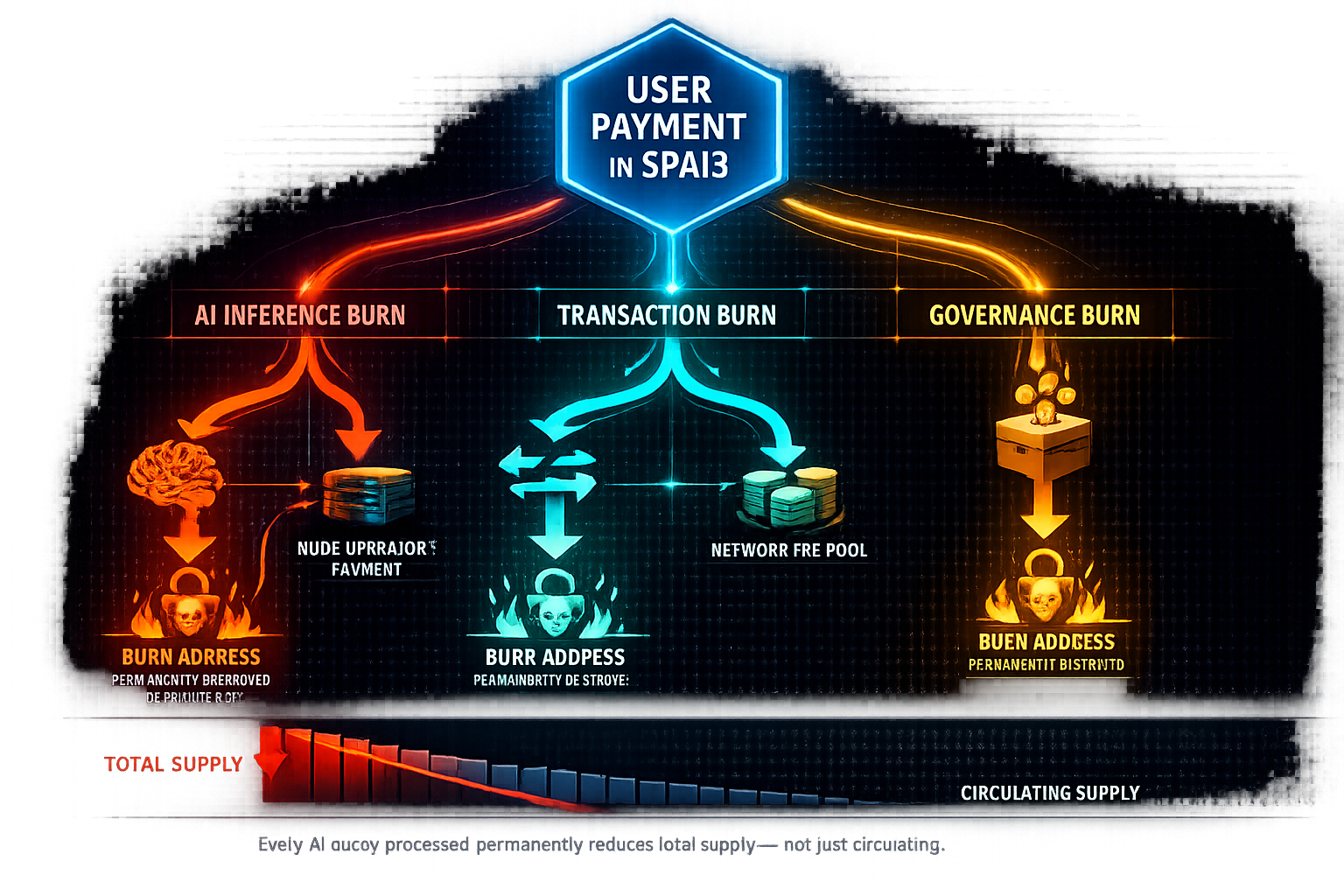
Vector one: AI inference burns. Every time a user or enterprise submits an AI query to the PAI3 network and pays in $PAI3, the smart contract automatically routes a portion of that payment to a burn address — an address with no private key, making the tokens permanently irrecoverable. The remainder flows to the node operator(s) who processed the request. This means every single AI computation the network performs permanently reduces total token supply (not circulating supply — the distinction matters and is explained below). The more queries processed, the faster tokens disappear. Post-mainnet (Q3 2026), when the full decentralised mesh network is operational with containerised AI applications running across distributed nodes, inference volume becomes the primary burn driver.
Vector two: transaction burns. Beyond inference payments, every on-chain $PAI3 transfer triggers a small burn. This includes marketplace purchases, token transfers between wallets, and any smart contract interaction involving $PAI3 movement. This functions as a transfer tax implemented within the BEP-20 token contract itself — a percentage is deducted from each transfer and sent to the burn address. This is mechanically distinct from Ethereum's EIP-1559 base fee burn, where ETH is burned from gas fees set algorithmically by the protocol. In PAI3's case, the burn is deducted directly from the transferred token amount (or charged as an additional fee on top of the transfer — the precise implementation has not been publicly documented). This distinction matters because BEP-20 transfer taxes can create compatibility issues with certain DEX routers, lending protocols, and composability with other DeFi contracts. Verify how the transfer tax interacts with PancakeSwap and other BNB-native protocols once the contract is deployed.
Vector three: governance proposal burns. Submitting a governance proposal to the PAI3 DAO requires burning $PAI3. This serves dual purposes: it creates a cost to prevent spam proposals (a real problem in DAOs — Nouns DAO and Compound have both struggled with low-quality governance spam), and it adds another vector of permanent supply removal. Crucially, this means the governance system itself is deflationary. The more actively the community governs, the more tokens are destroyed.
Critical terminology: Total supply vs. circulating supply
Burns and staking affect different supply metrics, and conflating them leads to flawed analysis. Burns reduce total (and maximum) supply — tokens sent to a burn address are destroyed forever, reducing the theoretical ceiling of tokens that can ever exist. Staking reduces circulating supply — tokens locked in staking contracts still exist but are temporarily unavailable for trading or transfer. The correct formula is: Circulating supply = Total supply − Burned tokens − Staked/locked tokens. When this article discusses burns, it refers to total supply reduction. When it discusses staking, it refers to circulating supply reduction. Both compress available tokens, but through fundamentally different mechanisms — one permanent, one reversible.
The compounding effect across all three burn vectors is where the model becomes structurally powerful. Consider a scenario where mainnet is live: enterprises are running healthcare diagnostics (inference burns), users are buying and selling AI agents on the marketplace (transaction burns), and the community is voting on network parameters (governance burns). All three vectors fire simultaneously, each one independent of the others. A decline in inference demand doesn't stop transaction and governance burns. A quiet governance period doesn't stop inference and transaction burns. The total burn rate is the sum of three independent streams, making it more resilient than single-vector deflationary models.
Burn rate scenarios (hypothetical modelling)
The exact burn percentages per inference, per transaction, and per governance proposal haven't been publicly disclosed as specific figures. However, meaningful analysis requires at least hypothetical modelling. Consider three scenarios based on a total supply of ~1.09 billion tokens:
- ›Conservative (1% inference burn, 0.5% transaction tax): If the network processes 100,000 inference queries/day at an average cost of 10 $PAI3 per query, that's 1M $PAI3 in inference payments daily, with 10,000 $PAI3 burned per day (~3.65M annually). At this rate, annual inference burns represent ~0.34% of total supply — meaningful but modest.
- ›Moderate (3% inference burn, 1% transaction tax): Same volume yields 30,000 $PAI3 burned daily from inference alone (~10.95M annually, ~1% of total supply). Add transaction burns from marketplace activity and transfers, and total annual burns could reach 1.5–2% of supply.
- ›Aggressive (5% inference burn, 2% transaction tax): 50,000 $PAI3 burned daily from inference (~18.25M annually). Combined with heavy transaction volume, annual burns could exceed 3% of total supply — genuinely significant deflation.
These are illustrative only. The actual burn rate depends on both the percentage parameters (set in the smart contract) and network utilisation volume. Insist on reviewing the finalised smart contract parameters before TGE to run your own models with real numbers.
The deflationary death spiral risk
The article would be incomplete without addressing what happens if deflation works too well. If $PAI3's price rises significantly due to supply contraction, and inference is priced in fixed $PAI3 amounts, the fiat-equivalent cost of AI services rises proportionally. A query costing 10 $PAI3 at $0.10/token ($1.00) becomes $10.00 if the token reaches $1.00 — making PAI3 uncompetitive with centralised AI providers like AWS or Google Cloud. This creates a negative feedback loop: high token prices → expensive inference → users leave → reduced burn volume → deflationary thesis collapses.
The solution is dynamic pricing — denominating inference costs in fiat equivalents (e.g., $0.01 per query) and adjusting the $PAI3 amount per query based on market price via an oracle. Whether PAI3 implements dynamic pricing is a critical design question that will determine whether deflation is self-sustaining or self-limiting. As of March 2026, the pricing mechanism for inference has not been publicly detailed. This is the single most important design decision for the long-term viability of the deflationary model.
Additionally, the smallest unit denomination of $PAI3 and how the token handles micro-payments at scale matters significantly. If inference must be priced competitively (fractions of a cent per lightweight query), the token contract needs sufficient decimal precision and the pricing oracle must handle rapid fiat-equivalent adjustments. These implementation details are not yet public but are essential for evaluating the model's practicality.
⚠ Common mistake: Assuming deflationary burns are constant, predictable, or unambiguously positive. The burn rate will fluctuate with network activity. In low-usage periods, deflation slows. In high-usage periods with fixed token pricing, deflation could make the network uncompetitive. This is a feature and a risk simultaneously — it means the deflationary pressure is genuine and usage-linked rather than artificially enforced, but it also means the model can break if pricing isn't dynamically managed.
Token Distribution — Where 150,000 $PAI3 Per Node Fits In
The standard explanation for token distribution is "X% to the team, Y% to the community, Z% to investors." That framing hides what actually matters: how many tokens enter circulation, when, and what structural pressures exist to absorb or counteract that inflow.
With a total maximum supply of ~1.09 billion $PAI3, here's what's concretely known. Each Power Node purchased receives an allocation of 150,000 $PAI3 at TGE. With 500+ Power Nodes sold as of March 2026, that's a minimum of ~75,000,000 $PAI3 committed to node operator distribution — approximately 6.9% of total supply. This is not new token minting — these come from a predetermined allocation pool within the fixed supply architecture.
What has NOT been disclosed: As of March 2026, PAI3 has not published a full token distribution table. The following allocation categories are referenced in project materials but without confirmed percentages:
| Allocation Category | Known Details | % of Total Supply |
|---|---|---|
| Power Node Rewards | 150,000 per node × 500+ nodes = ~75M+ tokens | ~6.9%+ |
| Community & Ecosystem | Referenced but unquantified | Not disclosed |
| Team Allocation | Vested (schedule not public) | Not disclosed |
| DAO Treasury | Controlled by quadratic voting governance | Not disclosed |
| Liquidity Provisions | For exchange listings | Not disclosed |
| Professional Node Staking Rewards | Post-mainnet | Not disclosed |
| Strategic Partners / Investors | If any | Not disclosed |
This opacity is itself a risk factor. Without knowing the full distribution breakdown, it's impossible to model sell pressure at TGE, assess insider concentration, or evaluate whether the deflationary mechanism can realistically offset distribution. For comparison, most serious token launches (Ethereum, Solana, Arbitrum, Optimism) publish detailed allocation tables months before TGE. If PAI3 does not publish a complete breakdown before the Q2 2026 TGE, participants are making capital allocation decisions with incomplete information. Demand this disclosure through governance channels or treat its absence as a warning sign.
The supply overhang question is the single most important variable for anyone entering at TGE. If all 150,000 tokens per node unlock immediately at TGE, 75M+ tokens hit the market at once across 500+ wallets. If they vest — say, linearly over 12 months — the circulating supply at TGE is dramatically lower, and sell pressure is distributed over time. This is the difference between a controlled launch and a supply flood. As of this writing, the precise unlock mechanics for Power Node allocations haven't been publicly finalised. Before committing capital at TGE, verifying this schedule through the official documentation at docs.pai3.ai is non-optional.
The team token vesting adds another layer. Vested team tokens are standard practice — Ethereum Foundation, Solana Labs, and most serious projects lock team allocations for 1–4 years with cliff periods. What matters is the cliff date and linear unlock rate. If PAI3's team tokens begin unlocking in Q3 or Q4 2026, that creates additional supply pressure precisely when mainnet launches. If the cliff extends to 2027, the mainnet period has breathing room. Watch for this disclosure as TGE approaches.
⚠ Common mistake: Treating 150,000 tokens per node as inflationary dilution. These tokens aren't minted on demand — they're pre-allocated from a fixed pool. The net effect on total supply depends entirely on whether burn rates eventually outpace distribution. In the early months post-TGE, distribution will almost certainly exceed burns. The crossover point is the key metric to track. But without the full distribution table, you cannot model when that crossover occurs.
Node Economics — How Power, Professional, and User Nodes Earn and Burn
The three-node architecture isn't just a product tiering decision — it creates distinct token velocity profiles that directly affect the deflationary model's real-world impact.
Power Nodes are physical hardware devices purchased outright. Operators own the equipment, run AI models on-premise, and receive 150,000 $PAI3 at TGE. The pricing follows an escalating bonding-curve-style mechanism that rewards early adopters while creating increasing commitment from later entrants. According to PAI3's marketing materials, the curve approaches approximately $38,013 at the 1,000th node — though this figure is unverified by independent sources and readers should confirm current pricing directly through pai3.ai. (If this price derives from a specific bonding curve formula, PAI3 should publish the formula for independent verification.) These nodes are built for enterprise deployment: HIPAA-compliant architecture means healthcare providers, legal firms, and financial institutions can run AI inference without sensitive data ever leaving their premises. PAI3 states that setup takes approximately five minutes, though this claim has not been independently verified and may vary based on network conditions and technical proficiency. Power Node operators face a sunk-cost anchoring effect: having committed thousands of dollars to hardware, selling the token allocation immediately would crystallise a loss on the total investment. This creates a behavioural bias toward holding, though it's not a guarantee — operators facing liquidity needs or doubting the project's trajectory will still sell.
Professional Nodes are software-based, with lower hardware requirements but a mandatory staking component. Operators must lock $PAI3 to participate, and earnings scale proportionally to compute contributed. These open to the public at mainnet (Q3 2026). The staking requirement creates a structural supply lock: every Professional Node operator removes tokens from circulating supply for the duration of their operation. If 1,000 Professional Nodes each stake 50,000 $PAI3, that's 50M tokens locked — circulating supply reduction independent of any burn mechanism (though these tokens still exist within total supply). The exact staking threshold hasn't been publicly confirmed. Professional Nodes are expected to handle mid-tier compute workloads — more demanding than edge-device inference but below the enterprise-grade processing that Power Nodes target. Their earnings model combines inference processing fees (a portion of the $PAI3 paid per query) with potential staking rewards, though the precise revenue split between node operators and the burn mechanism hasn't been disclosed.
User Nodes operate on personal devices, contributing lighter compute to the network. These represent the lowest barrier to entry and extend the network's total compute capacity at the edge. Based on available documentation, User Nodes are expected to handle lightweight inference tasks — natural language processing, basic classification, and other models that don't require GPU-intensive computation. Heavy compute workloads (large language model inference, image generation, complex medical diagnostics) would be routed to Power and Professional Nodes. Minimum hardware requirements for User Nodes have not been publicly specified, though the "personal device" framing suggests standard consumer hardware (modern laptop/desktop with adequate RAM and CPU). While individual User Node earnings will be smaller, each query processed still triggers an inference burn. At scale — thousands of personal devices each processing hundreds of lightweight queries daily — the aggregate burn contribution could be meaningful, though it will likely remain proportionally smaller than the burn volume generated by Power and Professional Nodes handling higher-value enterprise workloads.
Each node type interacts with the deflationary model differently. Power Nodes generate high-value enterprise inference that burns larger token amounts per query. Professional Nodes lock supply through staking while processing mid-tier compute. User Nodes process high-volume lightweight queries, each burning small amounts that aggregate across thousands of participants. The net deflationary effect depends on which tier dominates total inference volume — a question that won't be answerable until mainnet data is available in Q3 2026.
⚠ Common mistake: Assuming all node types generate equivalent economic returns. Power Nodes have the highest upfront cost but receive a guaranteed 150,000 $PAI3 allocation plus ongoing inference earnings. Professional Nodes require staking capital but no hardware purchase. User Nodes require neither significant capital nor hardware investment but generate proportionally lower returns. The risk-return profiles are fundamentally different, and comparing raw token yields without accounting for capital outlay is misleading.
Staking Mechanics — The Second Layer of Supply Compression
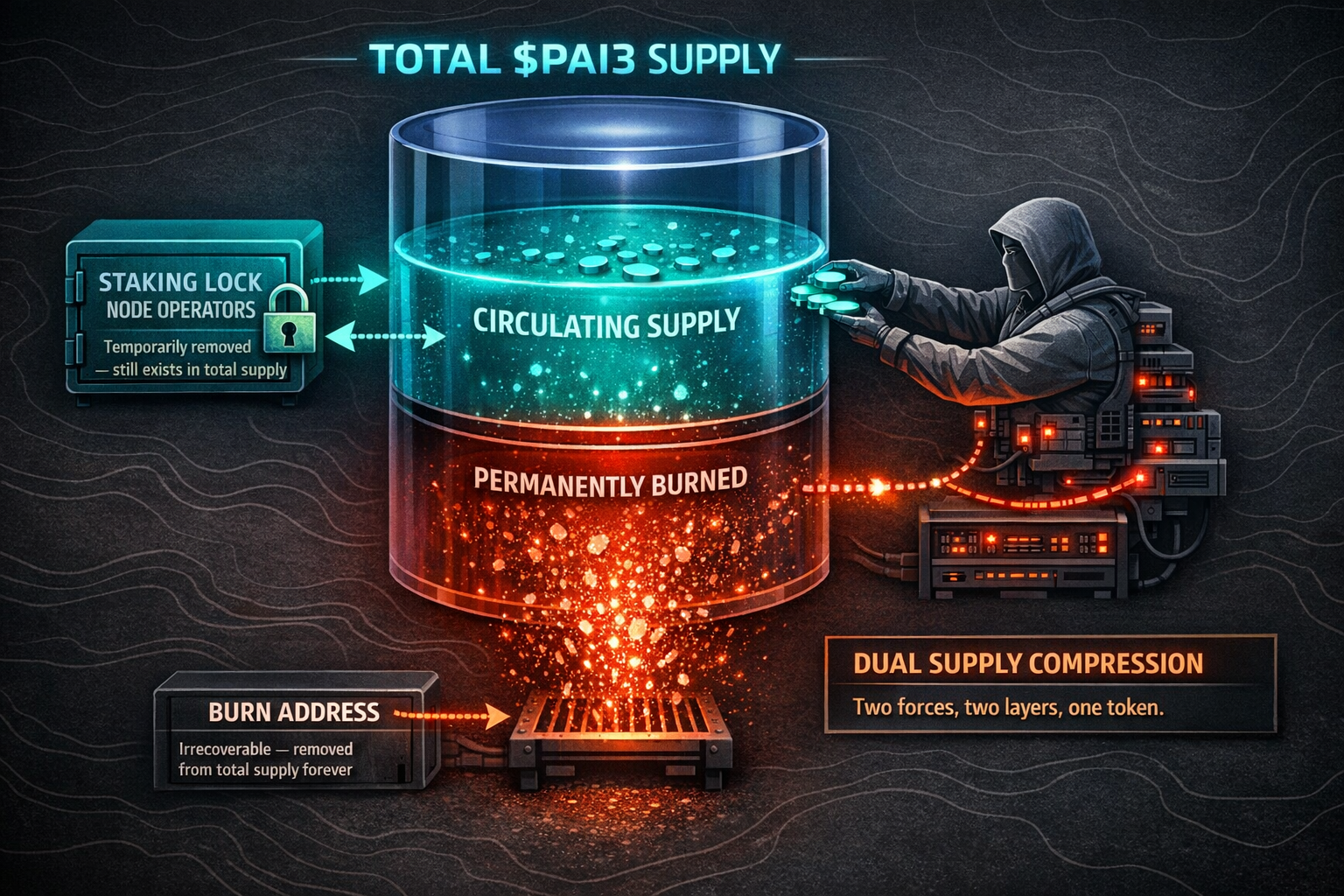
Burns and staking are treated as separate features in most token analyses. In $PAI3, they're architecturally intertwined, creating what amounts to dual supply compression — one mechanism permanently reducing total supply (burns), one temporarily reducing circulating supply (staking), both operating simultaneously.
Here's the mechanism: Professional Node operators must stake $PAI3 to participate in the network. Those staked tokens are locked and removed from circulating supply for the duration of their node operation — but they still exist within total supply. Simultaneously, the inference those nodes process triggers burns — permanently removing other tokens from total supply. The node operator is simultaneously reducing circulating supply (staking) and reducing total supply (processing burns). One wallet's participation creates two distinct supply compression forces operating on different metrics.
The compounding dynamic accelerates over time in a specific way that's worth modelling. As total supply decreases through burns, the staking ratio — staked tokens as a percentage of available (non-burned) supply — increases even if the absolute number of staked tokens stays flat. Working through this with explicit numbers against the ~1.09 billion total supply:
- ›Starting state: Total supply = 1,090,000,000. Burned = 0. Staked = 50,000,000. Circulating supply (total − burned − staked) = 1,040,000,000. Staking ratio (staked ÷ [total − burned]) = 4.6%.
- ›After 50M tokens burned: Total supply = 1,040,000,000. Staked = 50,000,000 (unchanged). Circulating supply = 990,000,000. Staking ratio = 50M ÷ 1,040M = 4.8%.
- ›After 200M tokens burned: Total supply = 890,000,000. Staked = 50,000,000 (unchanged). Circulating supply = 840,000,000. Staking ratio = 50M ÷ 890M = 5.6%.
Important caveat: a rising staking ratio caused by shrinking total supply (rather than growing absolute stake) is not automatically a health signal. If total supply is declining because burns are active but the absolute number of staked tokens is flat or declining, that could indicate stagnating or declining network participation — operators leaving rather than joining. The healthy scenario is rising staking ratio driven by both growing absolute stake (more operators joining) and declining total supply (active burns). Monitor both the numerator and denominator independently.
If you're modelling expected staking returns against the deflationary backdrop, our staking calculator can help you project scenarios where nominal APY and real purchasing-power yield diverge — because in a deflationary system, a 10% nominal yield on a token whose total supply shrinks by 5% annually translates to a higher effective return than the headline number suggests, assuming demand remains constant or grows.
⚠ Common mistake: Treating staking yield as inflationary because "new tokens are distributed to stakers." If staking rewards come from transaction fees and inference payments (redistribution) rather than new minting, they don't increase total supply. The net effect on supply depends on whether staking rewards exceed or fall below concurrent burn volume. Verify the source of staking rewards in the smart contract — minted vs. redistributed is a critical distinction. Also, don't conflate circulating supply reduction (staking) with total supply reduction (burns) — they're different mechanisms with different implications.
Quadratic Voting — Governance That Resists Whale Capture
One-token-one-vote governance, used by Uniswap, Compound, and most DAOs, has a well-documented problem: whales dominate. A single wallet holding 5% of supply can swing proposals unilaterally. Delegation models (Optimism's citizen house, ENS's delegate system) partially address this but introduce their own centralisation vectors through delegate capture.
Quadratic voting takes a mathematically precise approach. Voting power equals √(tokens staked). Work through the numbers with a consistent baseline: staking 1 token gives √1 = 1 vote. Staking 100 tokens gives √100 = 10 votes. Staking 10,000 tokens gives √10,000 = 100 votes. Staking 1,000,000 tokens gives √1,000,000 = 1,000 votes. Comparing two participants — one staking 1,000 tokens (√1,000 ≈ 31.6 votes) and one staking 1,000,000 tokens (√1,000,000 = 1,000 votes) — the whale has 1,000x the stake but only ~31.6x the voting power. Against the baseline of a single token (1 vote), a holder of 1,000,000 tokens gets 1,000 votes — that's 1,000x the tokens but only 1,000x the votes in absolute terms, which sounds linear until you realise the cost of each marginal vote rises quadratically. The 1,000th vote costs far more tokens than the 1st vote. This mathematical property — not just a marketing description of "fair voting" — is what makes quadratic voting fundamentally different from linear-weighted systems.
But there's a known vulnerability that experienced governance designers will immediately flag: Sybil attacks. If a whale splits 1,000,000 tokens across 1,000 wallets (1,000 each), each wallet gets √1,000 ≈ 31.6 votes, totalling ~31,600 votes — versus 1,000 votes from a single wallet holding all 1,000,000 tokens. Splitting tokens across wallets lets attackers substantially circumvent the quadratic cost curve — the attacker gains ~31.6x more voting power through splitting, though they still don't achieve full linear voting power (which would be 1,000,000 votes). The splitting also incurs gas costs for creating and funding multiple wallets, which on BNB Chain are minimal but non-zero.
The effectiveness of PAI3's quadratic voting depends entirely on its anti-Sybil mechanisms. As of March 2026, PAI3 has not publicly confirmed which specific anti-Sybil approach it will implement. Possible mechanisms include identity verification (KYC-linked wallets), wallet age requirements, proof-of-node-operation (tying voting rights to active node operators), or other reputation gates. Each approach has trade-offs: KYC conflicts with crypto privacy norms, wallet age is gameable with advance planning, and proof-of-node-operation limits governance participation to operators rather than all token holders. Until PAI3 confirms and deploys a specific anti-Sybil mechanism, this should be treated as an unresolved critical design gap rather than a hypothetical concern. Without robust Sybil resistance, quadratic voting collapses to something worse than linear voting because it creates a false sense of fairness while actually rewarding wallet splitting.
For $PAI3's tokenomics, governance isn't just a participation feature — it's a supply-affecting mechanism. Proposals govern fee structures (which determine transaction burn rates), AI scoring rules (which affect inference routing and therefore inference burn volume), treasury allocation (which determines how DAO funds are deployed), and partnership approvals (which affect enterprise demand). Governance decisions directly shape the parameters of the deflationary model itself. And since submitting proposals burns tokens, active governance is inherently deflationary.
⚠ Common mistake: Assuming quadratic voting automatically prevents whale dominance. Without strong Sybil resistance, it actually incentivises wallet splitting. Before participating in PAI3 governance, examine what identity or reputation requirements exist at the wallet level. If there are none, the quadratic model has a known exploit path.
The AI Inference Economy — Where Burns Meet Real Demand
The deflationary mechanism is only as powerful as the demand that drives it. Token burns tied to zero usage produce zero deflation. The actual question is: will enterprises and users pay $PAI3 for AI inference at meaningful volume?
The architecture supporting this demand has several concrete components. Containerised AI applications run across distributed nodes — modular, portable, and able to execute on any qualifying node in the network. The decentralised mesh network routes inference requests peer-to-peer, matching queries to nodes based on compute availability, specialisation, and reputation scores. The PAI3 Trust Economy adds a verification layer: inference results are scored on-chain, creating a reputation system where nodes that consistently deliver accurate, timely results earn higher priority for future queries. This is verifiable inference — not just a claim that results are correct, but an on-chain audit trail that enterprise clients can verify.
AgentOS — PAI3's platform for creating and deploying AI agents — introduces automated, recurring demand. When businesses deploy agents that continuously monitor data, generate analyses, or respond to triggers, each agent action constitutes an inference call. An enterprise running 50 agents performing 1,000 queries daily creates 50,000 inference burns per day from a single client. Multiply this across 40+ enterprise partners spanning healthcare, government, and finance sectors, and the potential burn volume becomes substantial.
The enterprise demand side deserves particular attention because it's structurally different from retail demand. Enterprises don't buy tokens to speculate — they buy tokens because they need to access a service. Healthcare providers running HIPAA-compliant AI diagnostics through PAI3 need $PAI3 tokens the same way AWS customers need a credit card on file. This demand is contractual, recurring, and indifferent to token price sentiment. If a hospital integrates PAI3 for radiology AI, it buys $PAI3 monthly regardless of whether the broader crypto market is bullish or bearish. This creates a structural demand floor that most token economies lack entirely.
⚠ Common mistake: Equating "40+ enterprise partners" with "40+ enterprises generating inference volume." Partnership agreements and production deployment are different stages. Enterprise integration cycles in healthcare and government are measured in quarters to years — compliance reviews, security audits, IT approval processes, training, and pilot programmes all precede production deployment. The metric that matters post-mainnet isn't partner count but inference volume — measured in queries per day, $PAI3 spent on inference, and tokens burned. Track this through whatever on-chain analytics PAI3 provides after mainnet launch.
Comparing $PAI3 to Other Decentralised AI Token Models
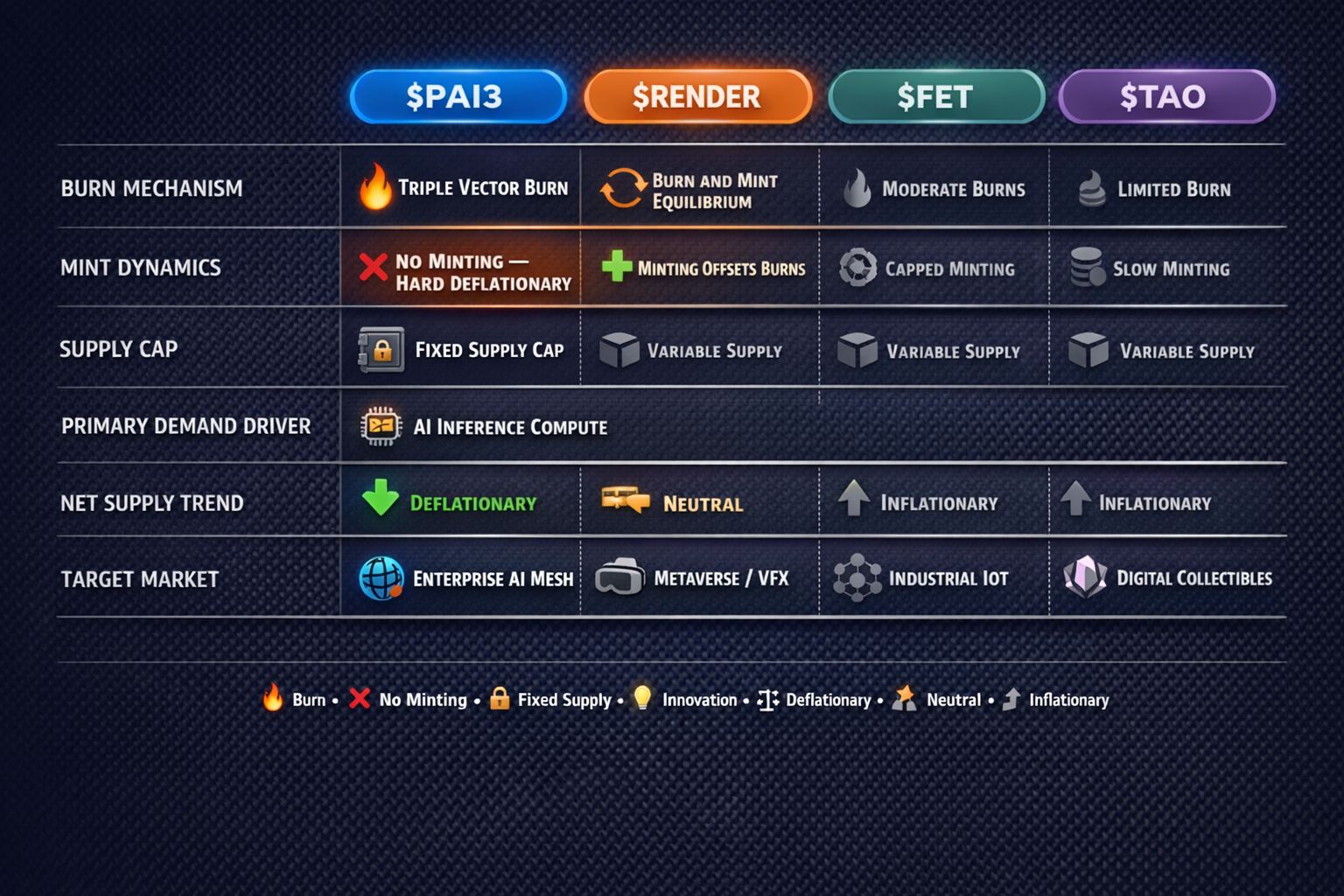
Lumping decentralised AI tokens into a single category is like saying Ethereum and Ripple are interchangeable because they're both blockchains. The differences in tokenomics, architecture, and target markets are fundamental. The comparison below includes both PAI3's direct competitors in decentralised AI compute and the generic burn-mechanism tokens referenced earlier.
Render Network ($RENDER) provides decentralised GPU rendering, initially focused on visual rendering (3D, motion graphics) and expanding into AI/ML compute. RENDER uses a burn-and-mint equilibrium (BME) model — $RENDER is burned when users pay for rendering work, and new tokens are minted as rewards for node operators. The net supply impact depends on whether burn volume exceeds mint volume. Unlike PAI3, Render doesn't offer on-premise hardware, HIPAA compliance, or governance-linked burns. Render's established network (live since 2020) provides real usage data — something PAI3 lacks until mainnet.
Akash Network ($AKT) is a decentralised cloud compute marketplace running on Cosmos. AKT is inflationary (staking rewards are minted), with deflationary pressure coming only from transaction fees. Akash focuses on general-purpose compute (containers, VMs) rather than AI-specific inference, and doesn't offer regulated-industry compliance architecture. AKT's inflation rate is a known quantity; PAI3's burn rate is entirely theoretical until mainnet.
Bittensor ($TAO) runs an emission-based model — new $TAO tokens are continuously minted and distributed to miners and validators. There is no burn mechanism. Supply increases over time, with scarcity relying on demand outpacing issuance (the Bitcoin model). Bittensor's focus is incentivising AI model training and validation through competitive subnets. There's no physical hardware ownership, no on-premise deployment, and no compliance architecture for regulated industries. If you're a hospital that needs HIPAA-compliant AI, Bittensor doesn't offer an architectural solution.
io.net aggregates underutilised GPU compute from data centres, crypto miners, and consumer devices. Its $IO token is used for payments and staking but doesn't embed multi-vector burns. io.net competes on raw GPU availability and pricing — a commoditised market where PAI3's differentiation lies in compliance, privacy, and the deflationary token model rather than compute cost alone.
Fetch.ai ($FET) concentrates on autonomous economic agents — software that negotiates and transacts on behalf of users. It's agent-focused without physical node infrastructure or on-premise compliance capabilities. The $FET token powers agent deployment and service payments but doesn't embed a multi-vector burn mechanism tied to inference processing. Fetch.ai and PAI3 overlap in the AI agent space (especially with AgentOS), but PAI3 combines agents with owned hardware and compliance — a different value proposition.
Ocean Protocol ($OCEAN) is fundamentally a data marketplace, not a compute network. It enables data sharing and monetisation through tokenised data assets. OCEAN tokens are used for staking on data sets and marketplace transactions, but the protocol doesn't perform AI inference or offer deflationary burns tied to compute processing. Ocean addresses a different part of the AI stack — data supply — while PAI3 addresses compute infrastructure.
| Feature | $PAI3 | $RENDER | $AKT | $TAO | $IO | $FET |
|---|---|---|---|---|---|---|
| Token model | Multi-vector burn (deflationary by design) | Burn-and-mint equilibrium | Inflationary (staking rewards) | Inflationary (emissions) | Payment + staking | Payment + staking |
| Physical node hardware | Yes (Power Nodes) | No | No | No | Aggregated GPUs | No |
| HIPAA compliance | Yes (on-premise) | No | No | No | No | No |
| Governance burns | Yes | No | No | No | No | No |
| Mainnet status (March 2026) | Pre-launch (Q3 2026) | Live | Live | Live | Live | Live |
PAI3's distinctive positioning is the combination of hardware ownership, privacy-first on-premise architecture, HIPAA compliance, and a multi-vector deflationary token model. No other decentralised AI project currently combines all four. However, PAI3's critical disadvantage relative to every competitor listed above is that it has no live mainnet data — its tokenomics are entirely theoretical until Q3 2026. Every competitor has real usage metrics that can be analysed today.
⚠ Common mistake: Evaluating decentralised AI tokens purely on price performance or market cap. The relevant comparison dimensions are tokenomic structure (inflationary vs. deflationary), infrastructure model (virtual vs. physical nodes), compliance readiness (regulated industries vs. crypto-native only), mainnet maturity, and governance mechanism. These structural differences determine long-term value accrual, not short-term price action.
Supply Dynamics Timeline — From TGE Through Mainnet and Beyond
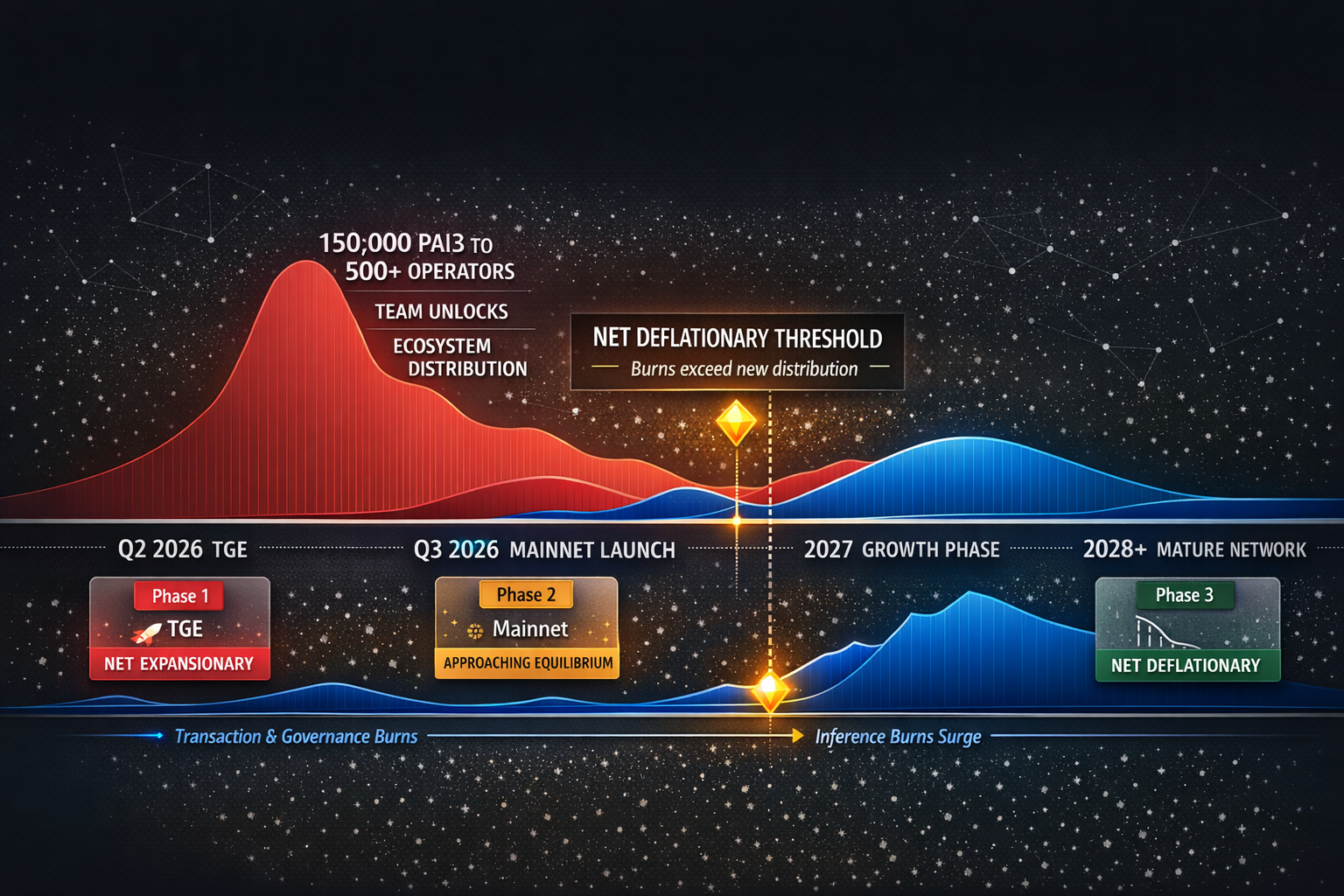
Here's what most deflationary token analyses get wrong: they describe the end state without mapping the path to get there. $PAI3's supply dynamics will move through distinct phases, and each phase has different net-supply characteristics.
Phase 1: TGE (Q2 2026). Tokens enter circulation for the first time. Power Node allocations of 150,000 $PAI3 begin reaching 500+ node operators. Community, ecosystem, and liquidity allocations also deploy. Transaction burns begin immediately — every DEX swap, every transfer triggers a small burn. But inference burns are minimal because mainnet isn't live. Governance burns begin as early proposals are submitted. The net supply direction in this phase is almost certainly expansionary — distribution of node rewards, team unlocks, and ecosystem allocations will exceed the nascent burn rate from transactions and governance alone. This is expected and not inherently negative, but anyone modelling immediate post-TGE deflation is likely wrong.
Phase 2: Mainnet (Q3 2026). This is the inflection point. The "World Computer" goes live, enabling full decentralised AI inference across the node network. Inference burns activate at scale for the first time. Professional Nodes open to the public, each one requiring staked $PAI3 — pulling tokens out of circulating supply (though not reducing total supply). The AI marketplace launches, adding transaction burn volume from agent purchases, model licensing, and service payments. Enterprise partners who've been waiting for production-ready infrastructure begin routing inference through the network. The burn rate accelerates across all three vectors simultaneously while new staking locks compound the circulating supply reduction.
Phase 3: PAI3 Computer (Q4 2026). The consumer hardware device introduces a mass-market demand vector. If operation or activation requires $PAI3 tokens, consumer-scale purchasing pressure hits a supply that has been under dual compression (burns reducing total supply + staking reducing circulating supply) for one to two quarters. The timing of this product relative to cumulative Q2–Q3 burns could create meaningful supply-demand imbalance. Sophisticated participants will recognise Q4 2026 as the potential demand catalyst, not Q2.
Long-term equilibrium. Pure deflation isn't indefinite. As total supply shrinks and token price rises, the fiat-denominated cost of AI inference increases (if priced in fixed $PAI3 amounts). The network must eventually either price inference in fiat-equivalent terms (adjusting the $PAI3 amount per query dynamically via a price oracle) or accept that rising token prices reduce demand. Whether PAI3 implements dynamic pricing for inference — denominating costs in dollar equivalents rather than fixed token amounts — determines whether deflation is self-sustaining or self-limiting. This is the critical design decision discussed in the deflationary death spiral risk section above.
⚠ Common mistake: Expecting deflation from day one. The early post-TGE period will almost certainly see net supply expansion. The transition to net deflation depends on mainnet inference volume, staking uptake, and enterprise adoption — none of which are guaranteed at specific levels. Model both bullish and bearish scenarios.
UK Tax Implications of $PAI3 Staking and Burns
UK-based participants face specific tax considerations under HMRC's cryptoasset guidance that interact directly with $PAI3's tokenomics. This section provides general guidance based on HMRC's published position — individual circumstances vary, and professional tax advice is recommended.
Receiving tokens from Power Node purchase. HMRC is likely to treat the receipt of 150,000 $PAI3 tokens as part of the Power Node transaction. The cost basis for these tokens would reasonably be linked to your Power Node purchase price, but whether HMRC treats this as a capital acquisition or as income (similar to mining rewards) depends on the specifics. If treated as capital, your cost basis per token = Power Node purchase price ÷ 150,000. If treated as income, the market value at receipt is taxable as miscellaneous income. Maintain detailed records of your purchase price, receipt date, and the token's market value at receipt.
Staking rewards. Under HMRC's CRYPTO61000 guidance, staking rewards are generally treated as taxable income at the point of receipt, valued at their market price on the date received. This applies regardless of whether you sell the tokens immediately. If you receive staking rewards worth £500 in a given tax year, that £500 is added to your taxable income — even if the tokens subsequently lose value. The cost basis for Capital Gains Tax purposes is then the market value at the time of receipt.
Token burns and deflation. Burns that reduce total supply and potentially increase the value of your remaining tokens do not trigger a taxable event for passive holders. HMRC taxes disposals (sales, swaps, gifts), not unrealised appreciation from supply contraction. However, if the transaction burn tax deducts tokens from your transfers, each such deduction could theoretically be treated as a disposal — this is an unsettled area of HMRC guidance. Keep records of every transaction where tokens are burned from your transfers.
Governance proposal burns. Burning $PAI3 to submit a governance proposal is a disposal of tokens. The Capital Gains Tax position depends on whether the burn amount exceeds your cost basis for those tokens. Even small burns should be tracked.
Tools like Koinly can automatically track BEP-20 token receipts, staking rewards, and burn-related disposals, calculating cost basis from TGE onward. Our crypto tax calculator can help estimate potential CGT liability. Get tracking set up from day one — retroactive tax accounting across hundreds of micro-transactions is significantly more painful than real-time tracking from inception.
⚠ Common mistake: Assuming crypto staking rewards aren't taxable until sold. Under HMRC guidance, staking rewards are income at receipt. Failing to report them is a compliance risk that compounds over time as HMRC increases data sharing agreements with exchanges and on-chain analytics providers.
Risks, Limitations, and What Could Break the Model
Any tokenomics analysis that doesn't address failure modes is marketing, not analysis. Here's what could go wrong.
Mainnet delay risk. The entire deflationary thesis depends on mainnet inference volume. If Q3 2026 slips to Q4 or 2027, tokens continue distributing through node rewards and ecosystem allocations while the primary burn mechanism (inference) remains inactive. Every month of delay is a month where supply expands without meaningful deflationary counterweight. Track the testnet-to-mainnet transition closely — the testnet has been live since Q3 2025, which is encouraging, but testnet stability and mainnet readiness are different benchmarks.
Enterprise adoption versus enterprise partnership. Forty-plus enterprise partners is a strong signal, but partnerships don't automatically equal inference volume. Enterprise integration cycles in healthcare and government are measured in quarters to years — compliance reviews, security audits, IT approval processes, training, and pilot programmes all precede production deployment. The burn rate depends on production inference volume, not partnership count. If enterprises are slow to move from signed agreements to live inference traffic, the deflationary model underperforms.
Deflationary death spiral. As discussed above, if $PAI3 is priced per inference in fixed token amounts, rising token prices directly increase the dollar cost of AI services. A query that costs 1 $PAI3 at $0.10 costs the enterprise $0.10. If deflation drives the price to $1.00, the same query costs $1.00 — a 10x increase that makes PAI3 uncompetitive with centralised alternatives. The network needs dynamic pricing (adjusting token amounts per query based on market price) to prevent deflation from killing demand. Whether this is implemented is a critical design question that PAI3 has not publicly addressed.
Burn rate opacity. As of March 2026, exact burn percentages — what fraction of each inference payment, each transaction, and each governance proposal is burned versus distributed — haven't been publicly documented in precise terms. A 1% inference burn creates dramatically different long-term supply dynamics than a 10% burn (see the hypothetical scenarios modelled above). Before the TGE, insist on reviewing the finalised smart contract parameters. Once deployed, you can verify burn rates directly on-chain by tracking transfers to the burn address using BscScan.
Smart contract risk. Security audits are underway this quarter (Q1 2026), but neither the auditing firm(s) nor any preliminary results have been publicly identified. The quality and scope of these audits matter enormously. A vulnerability in the burn function could mean tokens aren't actually being destroyed (they're sent to a recoverable address instead of a true burn address), or conversely, an exploit could burn tokens from arbitrary wallets. Demand to see completed audit reports from reputable, named firms before deploying significant capital at TGE. Unaudited or single-auditor contracts should be treated as high-risk, full stop.
BNB Chain centralisation risk. With approximately 40 active validators, BNB Chain is significantly more centralised than Ethereum. Regulatory action against Binance-affiliated validators, coordinated validator misbehaviour, or chain-level governance changes could affect all BEP-20 tokens including $PAI3. A project building "decentralised AI" on a relatively centralised base layer carries inherent philosophical and practical tension.
Token distribution opacity. As detailed in the distribution section, the full allocation table has not been published. Unknown insider allocations, undisclosed vesting schedules, and unquantified ecosystem funds create supply-side uncertainty that sophisticated participants should factor into their risk models.
Regulatory exposure. BNB Chain has faced regulatory scrutiny in multiple jurisdictions. Token classification uncertainty — whether $PAI3 is deemed a utility token, security, or something else — varies by jurisdiction and could affect exchange listings, enterprise adoption, and even the legality of node reward distributions. For UK-based participants, the FCA's evolving stance on crypto assets under FSMA regulations is particularly relevant — see the risk disclosures at the top of this article.
⚠ Common mistake: Dismissing risks because the tokenomic design is elegant. Elegant design and successful execution are different things. Every risk listed above is addressable, but none are addressed by default. Monitor execution against each risk factor independently.
Preparing for the $PAI3 TGE — A Practical Pre-Launch Checklist
The gap between knowing what $PAI3 is and being operationally prepared for its launch is where most people lose money — not through bad fundamentals but through preventable operational mistakes.
Contract verification. On TGE day, scam tokens with similar names will appear on DEXes within minutes. The only legitimate source for the $PAI3 contract address is pai3.ai and docs.pai3.ai. Cross-reference any contract address on BscScan before interacting with it. Check that the deployer address matches official announcements. Verify that the contract is marked as verified on BscScan with readable source code. If the contract is unverified or the source code isn't published, do not interact with it regardless of what Telegram groups claim.
Wallet security. If you're receiving 150,000 $PAI3 from a Power Node allocation, that's a non-trivial holding from day one. A hot wallet (browser extension MetaMask, mobile Trust Wallet) is acceptable for small amounts, but for a six-figure token allocation, a hardware wallet like Ledger is the baseline security requirement. Ensure your hardware wallet supports BEP-20 token management before TGE day — not during.
Tax positioning. In the UK, receiving tokens from a node purchase is likely treated by HMRC as a capital event or as income — see the UK Tax Implications section above for details. The cost basis for your 150,000 $PAI3 is arguably linked to your Power Node purchase price, but the specifics are complex and jurisdiction-dependent. Tools like Koinly can automatically track BEP-20 token receipts and calculate cost basis from TGE onward, and our crypto tax calculator can help estimate potential CGT liability before you make any moves. Get this right from day one — retroactive tax accounting is significantly more painful than setting up tracking at inception.
Post-TGE monitoring. Once the token is live, the metrics that matter are: total supply (decreasing through burns — track through BscScan), circulating supply (total minus burned minus staked — track through BscScan or whatever dashboard PAI3 provides), cumulative burn volume (monitor the burn address for incoming transactions), governance proposal frequency, and staking ratio. These data points tell you whether the deflationary model is activating as designed or underperforming. BscScan's token analytics page for the $PAI3 contract will show holder distribution, transfer volume, and burn address activity — use it.
How to verify key claims yourself
1. Burn address activity. Once $PAI3 is live, the burn address (typically 0x000...dead or a custom burn contract) will be visible on BscScan. Monitor incoming transactions to this address to verify burns are actually occurring and at what rate relative to total transfer volume.
2. Total and circulating supply. BscScan's token tracker page for the $PAI3 contract will show total supply minus burned tokens. Cross-reference this with any circulating supply figures published by PAI3 or listed on CoinGecko/CoinMarketCap post-listing. Remember: circulating supply = total supply − burned − staked/locked.
3. Smart contract audit reports. Once audits are completed (expected before Q2 2026 TGE), these should be published on docs.pai3.ai or directly by the auditing firms. If they aren't published, that's a significant red flag. Reputable auditors (CertiK, Trail of Bits, OpenZeppelin, Halborn) publish reports publicly as standard practice. Pay particular attention to the burn function implementation and whether the burn address is truly irrecoverable.
4. Governance proposals and staking data. Post-TGE governance activity should be trackable either through a PAI3 governance dashboard or directly on-chain. The number of proposals, voting participation rates, and tokens staked for governance all indicate whether the governance burn vector is active.
5. Inference volume and burn correlation. Post-mainnet, track daily inference transactions and correlate them with burn address inflows. This tells you the effective inference burn rate — the actual percentage being burned per query — which you can then use in your own supply modelling.
Next Steps
Read the smart contract. Once $PAI3 contracts are finalised and deployed, the verified source code on BscScan will contain the exact burn percentages, staking requirements, and governance mechanics. No amount of documentation substitutes for reading the contract itself. Start with the token contract's transfer function — that's where transaction burns are implemented.
Model the supply trajectory. Download the token distribution data from docs.pai3.ai when it's published. Build a spreadsheet with node reward unlock schedules, estimated burn rates at different inference volumes, and staking lock assumptions. Use the hypothetical scenarios from the burn vectors section as starting points, adjusting once real parameters are confirmed. Stress-test the model: what happens if only 10% of enterprise partners generate inference volume in Q3 2026? What if mainnet delays to Q4? What if inference burns are only 1% rather than 5%? Your investment thesis should survive your pessimistic scenario, not just your optimistic one.
Track the testnet. The PAI3 testnet has been live since Q3 2025. Testnet inference volume, node uptime, and error rates are leading indicators of mainnet readiness. Join the community channels — Telegram and Discord — where testnet performance data is discussed. Testnet participants often surface issues that formal announcements lag behind.
Understand quadratic voting mechanics before governance goes live. Review the governance documentation at docs.pai3.ai and model your own voting power at different staking levels. If you're a Power Node operator with 150,000 tokens, your maximum governance influence is √150,000 ≈ 387 votes. Understand what that means relative to expected participation rates before committing to governance positions. And critically, confirm what anti-Sybil mechanisms are in place before assuming the quadratic model delivers on its fairness promise.
Compare on-chain data post-launch against competitors. Use BscScan to track $PAI3's actual burn rate and compare it against protocols with known metrics — Render's BME data, Akash's transaction fees, BNB's Auto-Burn history, ETH's EIP-1559 base fee burns. This gives you a real-world benchmark for whether PAI3's usage-driven deflation is materialising at meaningful scale or remaining aspirational. The comparison against decentralised AI competitors (RNDR, AKT, TAO) is particularly important — they have live data that PAI3 does not yet have.
Demand the full token distribution table. Before TGE, PAI3 should publish a complete allocation breakdown (team, community, ecosystem, DAO treasury, node rewards, liquidity, investors). If this isn't available before you're asked to commit capital, you're making an investment decision without basic information. Advocate for transparency through community channels and governance discussions.